

Bridges are among the most demanding structures for a crane to help build. They must span obstacles that cannot easily be crossed by conventional construction equipment, whether deep river gorges, busy motorways, railway lines, or stretches of open water. Their components can weigh hundreds or even thousands of tonnes while the locations in which they are assembled frequently impose severe restrictions on access, available working space, and the positioning of machinery.
The challenge is not always the size of the load. A relatively modest bridge can require substantial lifting resources if it must be installed in a confined urban environment or manoeuvred into position without interrupting the infrastructure beneath it. Conversely, a major structure spanning a remote canyon may demand cranes capable of working at considerable height while contending with steep terrain, high winds and limited access.
Recent projects illustrate the breadth of equipment and techniques being used to overcome these obstacles. Tower cranes are constructing the pylons of major cable-stayed bridges, mobile cranes are installing massive concrete girders, and crawler cranes are supporting the gradual extension of steel structures across otherwise inaccessible terrain. Elsewhere, specialist lifting and transport systems are allowing entire bridge sections to be installed or removed in single operations.
Across these projects is the common requirement to coordinate lifting capacity, crane positioning, structural engineering, and construction sequencing. The equipment must do more than lift the load: it must enable the bridge to be built safely and efficiently within the constraints of its surroundings.
REACHING ACROSS THE DIVIDE
For bridges spanning deep valleys and gorges conventional access from below is often impractical. Crane positioning and the sequence in which structural elements are installed therefore become central to the construction method.
The Juneau Creek Bridge in Alaska, USA, demonstrates the scale of the challenge. With a span of 290 metres the bridge is the centrepiece of a major infrastructure project intended to improve capacity and safety on the Sterling Highway between Anchorage and the Kenai Peninsula.
Evansville, Indianna, USA -headquartered heavy-civil construction company Traylor Bros is using two Liebherr LR 1300.1 SX crawler cranes to support the assembly of the bridge’s steel girders. Rather than constructing extensive scaffolding across the deep Juneau Creek Canyon the project employs a bridge-launching technique. Steel sections are assembled on one side before hydraulic presses gradually push the structure across the canyon.
The cranes are crucial during the assembly and positioning of the individual girders. The steel components must be aligned with millimetre precision to achieve the required structural stability. Having a crane on each side of the project provides lifting capability across the construction area.
The bridge’s remote location, with limited access, make reliability particularly important – particularly in the harsh Alaskan environment.
The crawler cranes’ ability to travel on gradients is also important. Liebherr’s Gradient Travel Aid calculates each machine’s centre of gravity and monitors the permissible and actual gradient as it moves, warning the operator before the crane leaves its safe operating envelope. The main boom angle can be adjusted if necessary to help maintain stability.
Traylor Bros used Liebherr’s Crane Planner 2.0 software to simulate lifting operations and assess possible scenarios before and during construction. Such planning is particularly valuable where steep slopes, restricted access, and unpredictable weather leave little opportunity to recover lost time.
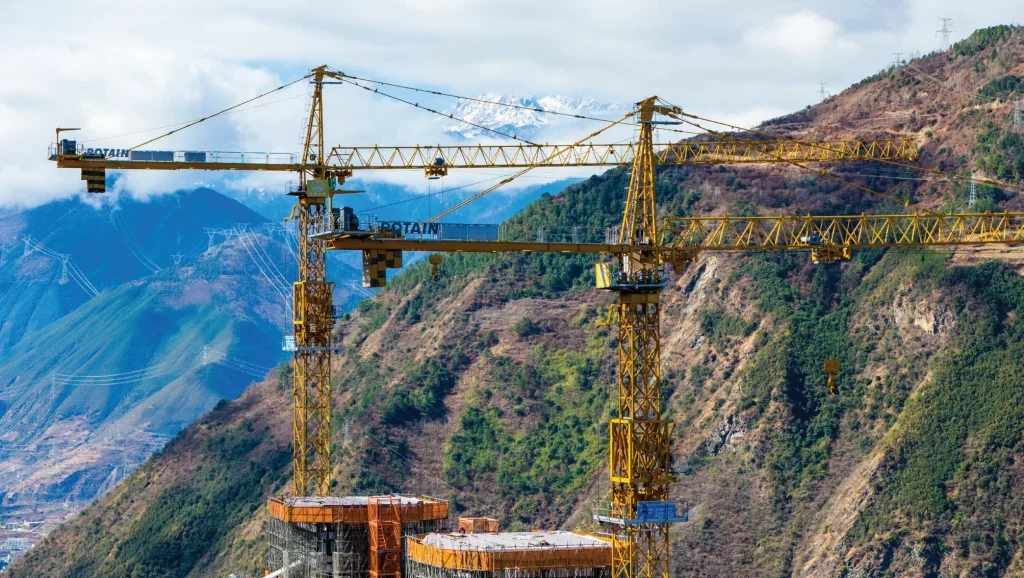
The challenges are different but no less demanding on China’s Luding Dadu River Bridge, part of the Sichuan–Tibet Railway. Three Potain MC 480 tower cranes supported construction of its two main pylons which rise to 262.8m and 255.8m respectively.
The bridge, which spans 1,060m, crosses mountainous terrain and a deep V-shaped canyon. The cranes operated with jib lengths between 40 and 60m using their maximum 25-tonne lifting capacity to handle materials and components during pylon construction.
One complication was the 21m steel formwork section used during the work. It offered no tie-off points for the cranes which therefore had to work around it as construction progressed upwards. The cranes also operated in close proximity with only 10m between their jibs during staggered operations.
Managing several tower cranes within such a restricted working envelope requires careful coordination of their movements, loads, and working sequences. The three machines completed the main pylons on schedule, despite the difficult terrain and strong winds.
Further east in China, on the coast near the city of Ningbo, two Potain MCT 385 topless tower cranes are supporting construction of the Zhoushan Taoyaomen Bridge – part of the Ningbo– Zhoushan Railway. The bridge will connect Fuchi and Cezi islands and feature a 666-metre main span. It is intended to become the world’s longest-span road–rail cablestayed hybrid-girder bridge.
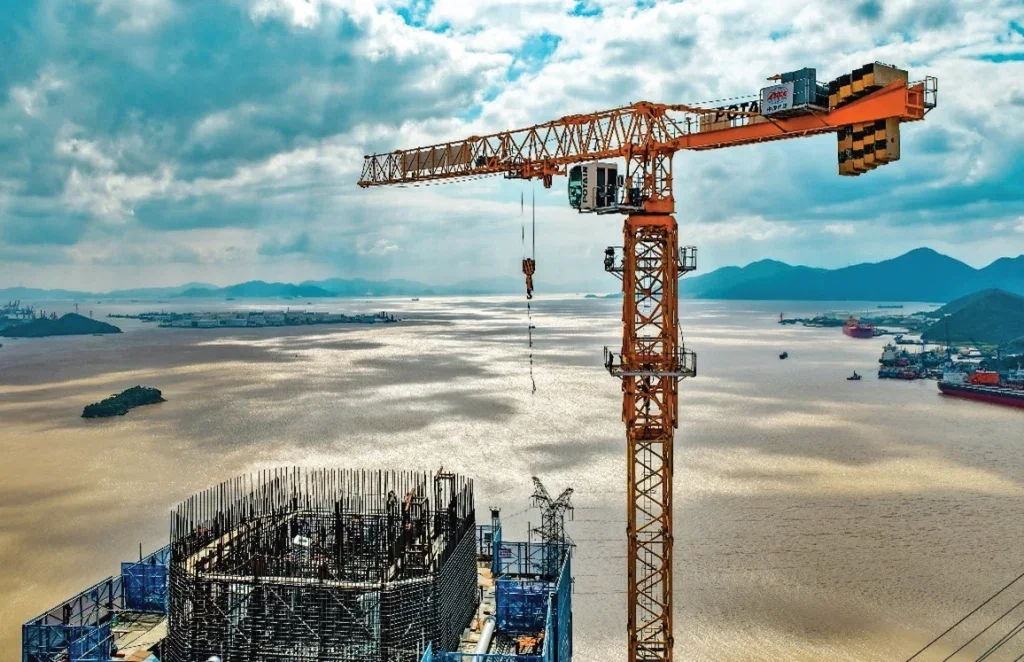
Pylon construction began in January 2025 with both of its 218-metre-tall main towers being successfully completed and capped in May 2026.
The cranes were selected for their ability to handle heavy loads accurately in the demanding marine environment. Their design also reduces the number of structural ties required – an advantage when erecting tall cranes around a growing bridge structure.
Although the Juneau Creek, Luding Dadu River and Taoyaomen projects differ in their structural designs and construction methods, each demonstrates how crane selection is influenced by the bridge’s geography.
The lifting equipment must be integrated into the construction method from the outset rather than treated as a resource that can simply be added once the engineering design is complete.
BUILDING UPWARDS
For cable-stayed bridges the pylons from which the deck is suspended present a particular lifting challenge. They must be constructed to considerable heights, often in exposed locations, while the crane must remain stable as the structure grows.
In Helsinki, Finland, a Liebherr 630 EC-H 40 Litronic tower crane supported construction of the 135-metre central pylon of the Kruunuvuori Bridge. The crane was deployed by Helsinki, Finland headquartered joint-venture construction consortium TYL Kruunusillat from winter 2022 until completion of the pylon’s structural work in 2025.
The bridge itself spans approximately 1.2 kilometres across Kruunuvuorenselkä bay, connecting several districts with central Helsinki. Designed for trams, pedestrians, and cyclists it is intended to provide a sustainable public transport link without accommodating private cars.
The pylon’s diamond-shaped reinforced concrete structure required the crane to undertake a variety of lifting operations at progressively higher levels. These included positioning formwork, lifting reinforcement cages, handling concrete delivery equipment, and installing structural components.
The 630 EC-H 40 Litronic has a maximum lifting capacity of 40 tonnes and an 80 metre jib. Its tower configuration and tie-in arrangements needed to be engineered specifically for the project, with Liebherr Tower Crane Solutions involved in calculating the mast configuration, anchoring geometry and adjustments required as construction advanced.
The location added to the complexity. The bridge crosses an exposed stretch of the Baltic Sea where the crane was subjected to strong winds and prolonged subzero temperatures. At the heights involved, wind forces acting on the crane and its connections required careful assessment.
The crane’s configuration also had to evolve alongside the pylon. Changes to tie positions and hook height needed to accommodate construction progress while maintaining the required structural integrity and operating conditions.
When the bridge opens to tram traffic, in late 2026, it will become Finland’s longest bridge and tallest bridge structure. Its planned 200- year service life also reflects the long-term infrastructure objectives underpinning the project.
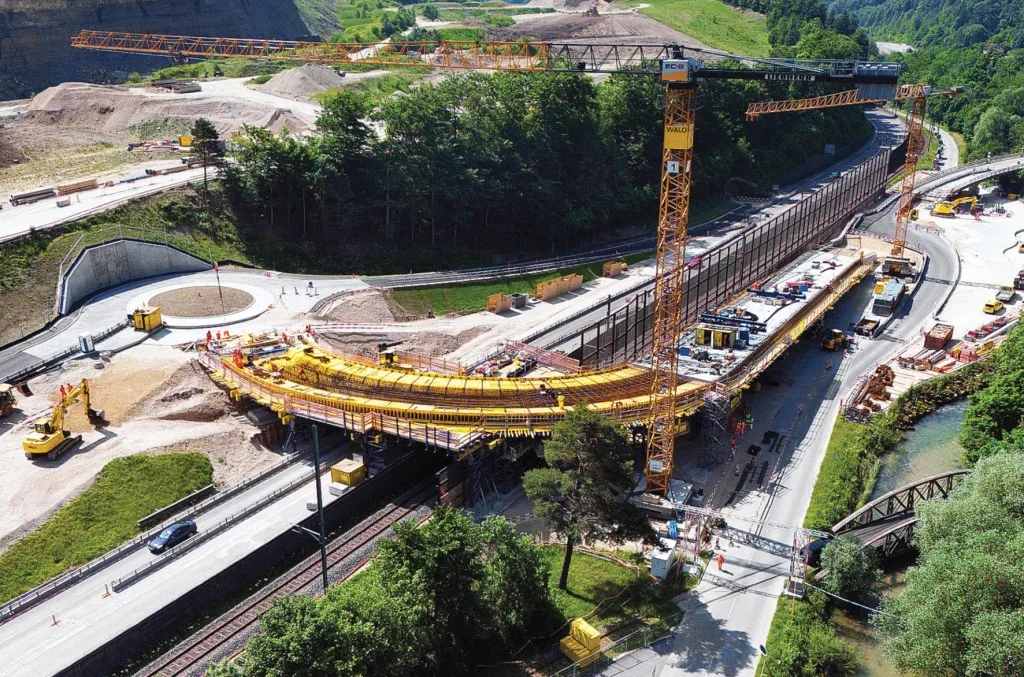
Tower cranes are equally important on less prominent but technically demanding projects. In Switzerland, seven Liebherr cranes have supported Walo Bertschinger AG’s work rebuilding two bridges on the N16 national road between Tavannes and Biel.
The construction site occupies a narrow valley, with a motorway, railway, and river running alongside one another. Two existing bridges sit immediately adjacent to the works while restrictions on deliveries limit the number of lorries that can reach the site each day.
The crane fleet has included 270 EC-B 12 and 90 EC-B 6 tower cranes together with smaller selferecting and other tower cranes deployed across different phases of the work. Their principal tasks include positioning steel girders for falsework, lifting timber formwork, placing reinforcement and handling auxiliary structures.
A particularly challenging operation involved erecting a 22m falsework structure without additional support at its centre. The temporary steelwork must support the bridge section while concrete is poured and cured, making its accurate installation essential to the construction sequence.
Working alongside an operational railway and motorway adds another layer of complexity. Crane movements and working radii have to comply with railway safety requirements, while some operations require night-time or weekend closures.
The project illustrates how several cranes can be deployed over an extended construction period to maintain a steady flow of materials and components. Their combined contribution is less about a single spectacular lift than about keeping a complicated construction site supplied and productive.
PEDESTRIAN PROJECTS
Where major bridge components arrive as large precast or fabricated sections, mobile cranes provide the flexibility to install them without requiring permanent lifting equipment to remain on site.
On the Traisen river in Austria, for example, Austrian crane company Prangl was appointed to install a new pedestrian and cycle bridge replacing a crossing dating from 1885.
The new 50m cantilever bridge weighed 39 tonnes and was designed to cross the river without supports in the water.
Its components were delivered to the riverbank, where an 80-tonne telescopic crane assisted with assembly.
Preparing the site required widening and reinforcing the access route, removing trees and constructing concrete foundations for the crane near the water’s edge.
For the final lift, Prangl deployed a 700-tonne telescopic crane configured with its main boom and 135 tonnes of ballast. The completed bridge was raised carefully, slewed through 90 degrees and lowered onto its prepared foundations.
While the Traisen project required a single crane to install a complete bridge, larger urban infrastructure schemes can demand several machines working together to handle heavier components. The challenge becomes more complex when lifting operations must also be completed quickly due to closures of the transport routes beneath them.
Madrid’s Parque Ventas project, for example, will create a pedestrian and green space spanning almost 200 metres across the M-30 motorway, linking the districts of Salamanca and Ciudad Lineal. The new area is intended to cover more than 16,000 square metres and is scheduled for completion by spring 2027.
Crane contractor Grúas Aguilar deployed seven Liebherr machines, ranging from a 95-tonne-class mobile crane to an 800-tonne-class model, together with an MK 140- 5.1 mobile construction crane.
The largest machines were responsible for installing concrete girders weighing up to 184 tonnes. The LTM 1650-8.1 and LTM 1750- 9.1 mobile cranes used telescopic booms extended to 40 metres, working at radii of up to 20 metres. Other cranes installed girders weighing approximately 120 tonnes and pillars weighing 25 tonnes, while the mobile construction crane handled floor slabs.
The motorway remained in operation during the wider project so the main lifting operations were scheduled at night. Work began at 10pm and had to be completed by 6am allowing traffic to resume each morning.
That timetable placed a premium on preparation. Crane positions, lifting configurations and the sequence of installations had to be determined in advance with little time available to resolve unforeseen problems once the road had been closed.
The project shows how multiple mobile cranes can be combined to handle a range of structural elements with the choice of machine matched to the weight, reach and geometry of each lift.
Elsewhere the deployment of increasingly high-capacity allterrains is extending the range of bridge components that can be lifted while retaining the flexibility to work across different sites.
In Pyeongtaek, South Korea, a 1,000-tonne-class XCMG XCA1000G8-1K all-terrain made its debut with a bridge-lifting operation. This was the first time a Chinese-branded all-terrain crane in this capacity class had been put to work in South Korea.
The XCA1000G8-1K has an eight-section, 102.5m main boom and can undertake lifts at heights of up to 100m using the main boom alone. Three outriggerspan configurations and three counterweight offset positions provide flexibility for different site conditions, while a transport height of four metres with the main boom and a width of 3.2m with the superlift system are intended to simplify mobilisation.
XCMG also provided support with equipment selection, configuration, lift planning and coordination with auxiliary equipment. This integrated approach reflects the importance of matching crane capabilities to the complete lifting operation, rather than assessing a machine on nominal capacity alone.
For bridge contractors the attraction of a high-capacity allterrain crane lies in its combination of lifting performance and mobility. The Pyeongtaek deployment also highlights the growing international reach of Chinese crane manufacturers as they compete in established markets for heavylifting equipment.
BRIDGE BY BOAT
High-capacity mobile cranes are not always the most practical solution, however. In densely developed urban environments, access restrictions can make it necessary to move bridge sections by water and use specialist lifting and transport systems to install them.
At Amsterdam Centraal Station the challenge was to replace a railway bridge while minimising disruption to rail services.
As part of the Netherlands’ High-Frequency Rail Transport programme infrastructure manager ProRail is upgrading five bridges to accommodate higher train volumes. Dutch heavy-lift specialist Mammoet has completed the second of these replacements, working with Rotterdam headquartered contractor Dura Vermeer.
The new bridge comprises three steel deck sections manufactured by Hollandia Infra.
Two of the sections measure 28.5m and weigh 275 tonnes each, while the central section is 21m long and weighs 175 tonnes.
Transporting these components through the densely developed city centre by road would have created significant logistical challenges. Instead, Mammoet brought them to the station by barge, partially submerging the vessel to pass beneath a low footbridge.
Once at the site, the sections were rotated through 90 degrees using self-propelled modular transporters (SPMTs) before being lifted into position.
Due to limited space Mammoet utilised a four-point lifting system on the quayside. Four hydraulic cylinders, which could extend together and move along tracks, raised the sections for precise positioning between surrounding bridge decks and columns.
The central section required a further sequence of manoeuvres. It was floated into position, rotated and temporarily supported on the existing bridge sections before the central column was constructed and the span lowered onto its permanent supports.
Each section took around a week to install. The operation demonstrates the value of combining waterborne transport, modular equipment and hydraulic lifting when conventional mobile crane access is impractical.
TANDEM LIFTS
Even where mobile cranes can reach, the work the geometry of a bridge component may demand a more complex lifting arrangement.
At Bad Neuenahr-Ahrweiler in Germany, Leipzig-headquartered crane company Richter Kran und Schwerlast utilised two Liebherr LTM 1750-9.1 mobile cranes to install a 105-tonne bridge segment for the new Landgrafenbrücke.
The previous bridge had been destroyed during the catastrophic floods that struck the Ahr Valley in July 2021. Its replacement forms part of the wider reconstruction of local infrastructure.
The main operation required both cranes to lift the segment in tandem, working at a maximum radius of 38m. Each crane was configured with a 28m luffing jib and 204 tonnes of counterweight.
The restricted space on the riverbanks meant the cranes had to be positioned close together. A triangular spreader beam was used to distribute the load between them, requiring the operators to maintain precise control throughout the lift.
The operation was scheduled for 4am, when lower temperatures would minimise thermal expansion of the steel girder so that it would fit into its designated abutments.
Tandem lifting introduces an additional level of coordination because the load must be shared correctly between two machines throughout the operation. Crane positions, boom configurations, load distribution and movements must all be carefully controlled.
After installation one crane was dismantled while the other moved to the opposite bank to complete further work.
Temporary crossings can also require carefully coordinated operations, particularly when a structure must first be assembled from individual components before being placed across a river or transport route.
The Federal Agency for Technical Relief (THW), Germany’s civil protection and disaster relief organisation, erected a 70m-long temporary crossing to carry traffic while the existing bridge is demolished and replaced. Four Liebherr LTC 1050-3.1 compact cranes were used to assemble the steel truss structure.
The four bridge segments, each weighing around 100 tonnes, were pre-assembled from hundreds of individual components. The compact cranes then helped join the sections into a continuous structure before it was pushed around halfway across the river.
The restricted pre-assembly site was crowded with stored materials, lorries, forklifts and other equipment. Removing the front storage box from some of the cranes reduced their vehicle length to 10.35m, improving manoeuvrability in the available space.
Their height-adjustable operator cabs also provided an advantage, allowing operators to maintain a direct view of colleagues working on the upper steel sections.
For the final placement two Liebherr LTM 1650-8.1 mobile cranes, supplied by MSG Krandienst and Scholpp Kran & Transport, lifted the assembled structure onto the abutments in a tandem operation.
The temporary crossing is intended to remain in service for two years. The exercise was also part of THW’s ongoing training programme, which maintains specialist bridgebuilding teams across Germany.
ACCESS IS ESSENTIAL
Not every bridge project involves loads weighing hundreds of tonnes. In some cases the principal challenge is getting the crane to the site and establishing a safe working position.
On Mosquito Road in Placerville, California, heavy civil construction and sustainable infrastructure contractor Shimmick Construction utilised a Link-Belt RTC-80130 Series Two rough terrain in the construction of a new bridge to improve emergency services access to nearby forested areas.
The new crossing will span approximately 1,200 feet over the south fork of the American River. The existing timber bridge, built in 1939, will be retained as a pedestrian crossing.
The crane’s reach made it suitable for work on the northern side of the new bridge, where it lifted 7,500 lb (3.4 tonne) shoring beams at a radius of 90 feet (27.4m).
Before it could begin lifting, however, the machine had to negotiate nearly five miles of dirt roads, steep grades, and switchbacks through the Eldorado National Forest. The journey took almost four hours – demonstrating the importance of mobility in a remote construction environment.
After the bridge deck was completed the crane travelled approximately 10 miles to assist with dismantling the temporary concrete batch plant that was used to pour the bridge’s deck surface and substructure.
One of the tasks involved tipping the plant machinery weighing 78,000 lb (35 tonnes) to enable its disassembly and removal.
The project illustrates the value of a rough terrain crane that can travel, under its own power, through difficult access routes, and then undertake lifting duties without requiring the same mobilisation arrangements as some larger machines.
REMOVING THE OLD
Bridge construction also encompasses the removal of obsolete structures, sometimes presenting lifting challenges as demanding as those involved in installing their replacements.
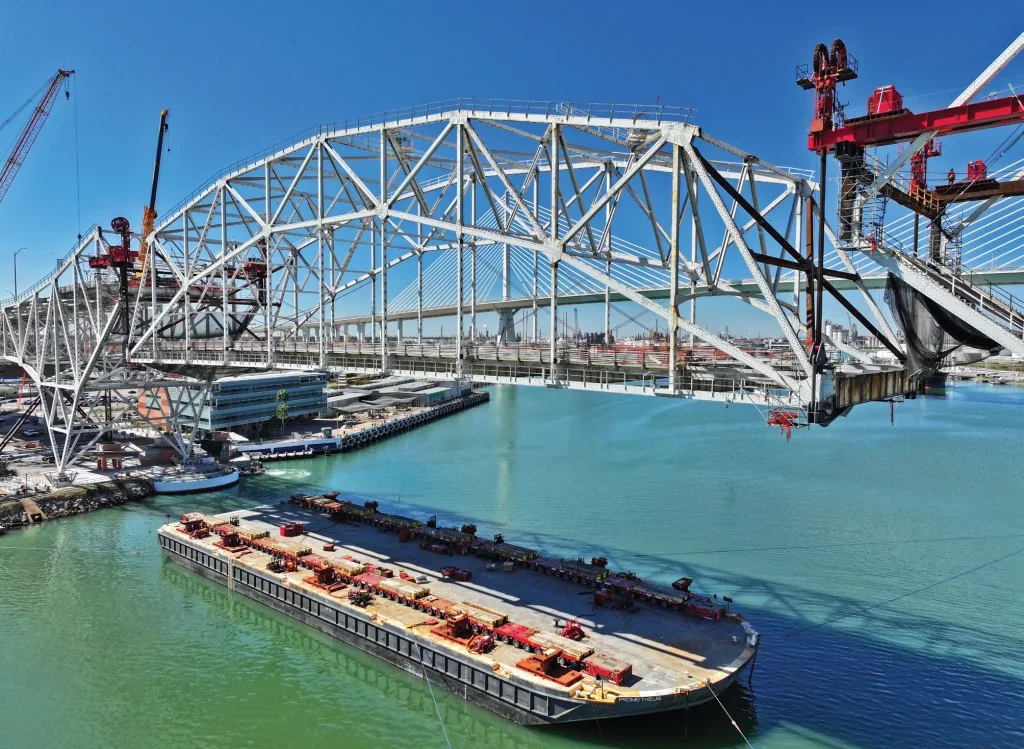
In Corpus Christi, Texas, the replacement of the US 181 Harbor Bridge required the removal of the central span of the historic 1959 structure. The 2,300-tonne steel truss was lowered in one piece onto a barge avoiding the need for conventional dismantling at height or controlled explosive demolition.
Mammoet advised project developer Flatiron/Dragados and the Texas Department of Transportation on the removal method. The team assessed several options before selecting a lift-andlower approach, which reduced the number of workers required at height and helped protect the nearby marine environment.
Four 900-tonne-capacity strand jacks, positioned at either end of the span, took the structure’s weight while its connections were cut. The span was then lowered nearly 50m using 54 strand wires.
Preparation was critical. An initial cut allowed the team to raise the bridge slightly and check its deflection before proceeding. Engineers also incorporated a contingency into the lifting capacity because the 2,300-tonne weight had been estimated from historical records.
The strand wires presented a logistical challenge because of their length. Rather than laying them across the bridge deck and arranging them manually Mammoet used two coilers to prepare the wires in advance, reducing the work required on site.
A barge equipped with winches, support grillages and SPMTs was positioned beneath the span. Once the bridge had been lowered and secured, the vessel transported it approximately ten nautical miles to a nearby dock.
There 108 lines of SPMTs, arranged as two sets of 54, supported the next phase of the operation. Steel reinforcement was welded beneath the span while it rested on the barge avoiding the need to carry out this work at height. The transporters then moved the structure onto supports for decommissioning.
The entire operation had to fit within a 36-hour window to clear the navigation channel. Daylight was selected for the lowering phase to improve visibility and support safe execution.
The Harbor Bridge operation shows that heavy lifting is often about selecting the right method rather than simply deploying the largest crane available.
Strand jacks and SPMTs provided the controlled vertical movement and horizontal transport needed to remove a structure that would have been difficult to dismantle conventionally.
A different combination of equipment was used to remove an old access bridge over the River Derwent in England.
Following construction of a replacement crossing Shrewsbury-headquartered bridge builder and specialist contractor Beaver Bridges commissioned a 600-tonne-capacity Terex-Demag TC 2800 lattice-boom crane and a 230-tonne-capacity Liebherr LTM 1230-5.1 all-terrain mobile crane from Ainscough Crane Hire to remove the existing structure.
The bridge measured 34m long and 4.5m wide and weighed more than 117 tonnes. The project team decided to lift it out in one piece rather than dismantle it on site.
The TC 2800 performed the primary lift, with the LTM 1230- 5.1 acting as the secondary crane. Below the main crane, a 17m, 150-tonne-capacity Modulift spreader beam was rigged above two CMOD70 spreader frames, each measuring 10m by 3m and rated at 60 tonnes.
The frames provided multiple pick points, with collar chains passed through the bridge and connected to slings. This arrangement distributed the lifting forces across the structure and enabled the bridge to be removed as a single unit.
The operation also highlights the importance of defining responsibilities clearly. Beaver Bridges hired the cranes under Construction Plant-hire Association crane-hire terms, retaining responsibility for planning and supervising the lift. Ainscough supplied the cranes and operators, while lifting-equipment specialist RSS supplied and coordinated the rigging gear.
The arrangement was not a contract lift, under which the crane hire company would normally assume responsibility for planning and managing the lifting operation. Instead, the project relied on close cooperation between the hirer, crane provider and lifting-equipment supplier, with responsibilities defined in advance.
Once removed, the old bridge was taken away for scrap. The project shows that even a relatively short structure can demand substantial lifting capacity and carefully engineered below-thehook equipment when it must be moved intact.
PRECISION & PLANNING
Across these projects the role of cranes in bridge construction extends well beyond raw lifting capacity. The machines must be selected around the bridge design, the component weights and dimensions, the available ground conditions and the sequence in which work can be undertaken.
The examples also underline the importance of complementary equipment. Tower cranes provide sustained lifting capability as pylons rise; mobile and crawler cranes offer the capacity and mobility required for heavy components; compact cranes assist with assembly in restricted spaces; and strand jacks, hydraulic lifting systems and SPMTs provide alternatives where conventional crane access is impractical.
Planning is equally important. Simulation software, engineered lifting frames, tandem-lift procedures and carefully selected working windows all help reduce uncertainty when components must be installed to tight tolerances or within short periods of access.
Bridge projects can also impact activity beyond the construction site. Maintaining motorway traffic, keeping railway services operational, reopening shipping lanes and protecting nearby communities can determine both how and when lifting operations take place.
Ultimately, the successful construction of a bridge depends on bringing together structural engineering, lifting technology, logistics and experienced personnel. The crane may be the most visible part of the operation but its effectiveness rests on everything around it: the preparation of the site, the design of the lift, and the coordination of the teams responsible for delivering it.
As infrastructure owners continue to replace ageing crossings, expand transport networks, and reconnect communities the demands placed on lifting equipment will remain varied. Some projects will require the controlled installation of enormous girders, others the assembly of structures above deep valleys, and some the removal of long-standing bridges.
What unites them is the need to bridge the gap between ambitious engineering design and the realities of building it. For crane contractors and equipment suppliers that remains one of infrastructure construction’s most exacting tests.


