

When it comes to the electrification of the mobile crane sector there was a real buzz at the Bauma 2025 tradeshow in Munich, Germany, around new hybrid all terrains, with crane manufacturers Tadano, Liebherr and Manitowoc all showcasing new models.
Tadano presented two new all terrain cranes, the AC 4.070HL-1 and the AC 5.120H-1, intended to serve as the introduction to a new hybrid concept with a battery electric superstructure.
The AC 4.070HL-1 is the market-ready version of the four-axle 70-tonne crane that it showcased as a tech demo back in 2022. Since then, Tadano says, the corresponding pre-production models have received an overwhelmingly positive response after both testing and real-life use.
The 120-tonne AC 5.120H-1 crane, which was developed on the basis of this experience, is the next model in the series and was seen at the show for the first time.
The backdrop behind these new hybrid crane developments consists of Tadano’s ambitious “Tadano Green Solutions” (TGS) environmental protection strategy, which has the goal of reducing the company’s CO2 emissions between 2019 and 2030 by 25% worldwide. Over the same period, Tadano aims to cut CO2 emissions from the use of its products by 35%. The goal is to be completely climate neutral by 2050. One important step towards this goal consists of our hybrid crane solutions, which generate about 60% less CO2 than diesel-powered superstructures. Electric crane operation has a system efficiency of around 85%, which represents more than double the energy efficiency of an efficient diesel engine.

Flexible power options
A combination of conventional travel and fully electric on-site operation is made possible by the new Tadano AC 4.070HL-1 hybrid crane and the upcoming AC 5.120H-1. More specifically, the diesel carrier engine is responsible for bringing the crane to its work site, where the engine can then be switched off for the duration of the job once the outriggers have been deployed. Meanwhile, the high-voltage (HV) battery in the superstructure powers an electric motor, as well as the thermal management system and the superstructure cab’s air conditioning. The electric motor powers the hydraulic system used for crane operation, all with zero restrictions on the corresponding performance. Tadano hybrid cranes can be operated both self-sufficiently with their own battery power and with the support of an external power source, such as temporary work site power. The latter not only extends a unit’s multi-hour electric runtime, but can also relieve the load on the HV battery. In addition, these hybrid cranes remain fully operational even when the HV battery is fully depleted and no external power supply is available. This is thanks to a generator that is driven by a power take-off on the carrier’s diesel engine and that charges the HV battery and allows for continued crane operation. Finally, the hybrid cranes also feature a separate and time-tested 24-V vehicle electrical system that can be used for de-rigging in case of emergency.
Tadano says that crane owners and rental companies can benefit directly from reduced operating costs as a result of the maintenance-free electric motor and the elimination of the superstructure diesel engine. In addition, these hybrid solutions make it possible to tackle new jobs in areas where noise and exhaust emissions must be kept to a minimum. There is also the boost in terms of environmental image which it says should not be underestimated and can continue to pay dividends long after paying the acquisition costs for the crane.
For companies with solar panels at their yard, free and straightforward charging becomes an additional business and environmental plus.
The electric motor means that there are no exhaust emissions anymore and that vibration and noise are kept to a minimum, all of which is coupled with continuous heating and air conditioning even in standby mode. This makes working in the superstructure cab and in the crane’s proximity much more pleasant, and safer as important noises and instructions can be heard better at work sites. Moreover, all stakeholders benefit from a high level of operational reliability resulting from power source redundancy. The hybrid crane operation can offer a reduction in CO2 emissions of around 60%, says Tadano.
The HV components and their accessories in the superstructure are housed in the packaging space that would normally correspond to the eliminated superstructure engine. The compact electric motor is in the exact same position as the internal combustion engine it replaces, and runs with the same maximum speed. This makes it possible for the hydraulic unit used for crane operation to remain unchanged and in its original position. Tadano points out this is a major plus when it comes to maintenance and spare parts for the unit, which can be smoothly activated and deactivated. The HV battery is located above the electric motor, surrounded by battery thermal management system components and battery management system components. The HV components’ layout is optimised for short cable runs, good coolant flow to cooling elements, and ease of maintenance and repair. The vehicle inlet for charging can be found on the right side of the rear end, leaving enough storage space to the left, as well as enough space for a trailer hitch in the centre. When selecting HV components, Tadano follows its tried-and-true strategy of using components that come from reputable suppliers and confirm to well-established industry standards. As a result, the HV battery has a modular design and can be accessed in a straightforward manner.
In battery-only mode the charged HV battery supplies all the power that the electric motor needs in order to drive the crane’s hydraulic pump. In this mode the AC 4.070HL-1 can run for more than four hours with a full battery charge, while the AC 5.120H-1 can run for an entire working day under the same conditions.
In battery mode assisted by external power supply during crane operation and pauses in operation the HV battery is continuously recharged through the external power supply connected to the CEE vehicle inlet. Depending on the selected amperage, this makes continuous electric crane operation possible.
External-power-supply-only mode means that even if the HV battery is depleted, the crane can continue to work through its external power connection. Since the HV battery is also charged during pauses in crane operation, it can deliver levels of performance exceeding the externally supplied energy after charging briefly.
In battery mode assisted by generator the carrier’s diesel engine charges the HV battery with the generator and the battery buffers the supplied power. Accordingly, the crane’s hydraulic system can briefly work with peak loads that are significantly greater than the maximum continuous power supplied by the generator. The generator can be used during travel and when stationary, and can work in three operating modes: silent mode, eco mode, and power mode. Thanks to the manual regenerative braking function, the generator can run when the vehicle is coasting during travel, saving fuel as a result. This reduces the load on the retarder and boosts the crane’s braking action.
There is also an emergency operation function where the crane can be de-rigged with the 24-V vehicle electrical system. Here the telescoping sections are retracted and the boom is lowered to its transport position.
The high-voltage system on the AC 4.070HL-1 has been customised to match the power required by the unchanged hydraulic system. Tadano says its system voltage of up to 800 V means that the Tadano hybrid crane is leading the pack in line with the latest cutting-edge battery electric trucks and passenger cars. The unit’s other parameters include:
- HV battery pack: lithium-ion NMC battery (nickel manganese cobalt)
- Battery capacity: 70 kWh total capacity, of which approx. 80% (~56 kWh) is usable
- Electric motor: continuous output of 115 kW, peak torque of 1,200 Nm
- Generator: charging power > 50 kW, continuous output of 85 kW, peak torque of 500 Nm
- Onboard charger: CEE vehicle inlet, 400 VAC, 63 A, limiting to 32 A possible
- Battery runtime: approx. 6.3 h (load cycle 1), approx. 3.9 h (load cycle 3)
- Charging time with onboard charger (63 A): 10% to 90% state of charge (SoC) in approx. 1 h
- Charging time with generator while working at work sites: 10% to 90% SoC in approx. 1 h
- Charging time with generator during travel: +55% SoC in approx. 1 h

Strong performance
Tadano hybrid cranes have the exact same lifting performance, lifting capacities and axle load capacities as their counterparts with two internal combustion engines, meaning that the slight increase in weight represented by the hybrid system is not tied to any loss of performance.
As with other electric vehicles, the purchase price is higher than that of comparable models with an internal combustion engine. These hybrid cranes, however, pay for themselves as a result of their extra advantages Tadano claims. It also says quiet and zero-exhaust-emission crane operation means that new applications and potential sources of revenue can be tapped into. For example, they can be used in: indoor areas (e.g., buildings in the event, manufacturing, and logistics industries); outdoor areas sensitive to exhaust and noise emissions (e.g., urban areas, hospital grounds, zoos, nature reserves, occupied residential buildings); and also used during quiet hours (at night, on Sundays and public holidays)
Investing in the future
Tadano hybrid cranes are designed for long-term use, making them a sound investment in the future. Tadano says that is possible that by the end of the 2030s, electricity will be much more affordable than diesel fuel in comparison to today. Moreover, additional and tougher regulations requiring zero-emission and low-noise operation are expected by then. The company believes that customers are likely to be glad they invested in a Tadano hybrid crane as a result of significant fuel and engine maintenance savings across the years combined with excellent resale value.
In addition, the equipment is designed to last: Not only are the vehicle structure, chassis, hydraulic system, and crane mechanical system all characterised by heavy-duty robustness but the high-voltage system is made of durable and modular components as well.
The thermal management system ensures that the HV battery always works at its optimal operating temperature and that it will reach its optimal service life. The result is a high residual capacity of about 80% of the new battery’s SoH (state of health) even after 3,000 charging cycles. Partial charges only count towards these cycles proportionally and have a more positive effect on the battery’s lifespan the longer and more frequently the state of charge remains in the middle range.
When it comes to the software used to integrate the high-voltage system the HV components are linked and controlled with in-house software developed internally by the company with its own IT resources to ensure the hybrid cranes’ reliable suitability for daily use. The crane functions remain hydraulically powered. This, Tadano says, gives crane operators highly responsive control feedback, particularly since all HV-specific information has been smoothly integrated into the display solution.
The hybrid crane design was planned in such a way as to be used across models, so that Tadano’s electrification for the AC 5.120H-1 is based directly on that of the AC 4.070HL-1. The front section of the five-axle crane’s superstructure supports an optional second HV battery pack. This doubling of the battery capacity to a total capacity of 140 kWh means that battery electric operation for a full working day without any external charging is possible. Thanks to the optimised compact rear storage box next to the vehicle inlet, the machine can carry the usual crane equipment. The generator drive has been optimised further and runs maintenance-free directly off the transfer case between the second and third axles.
Tadano says the extraordinarily positive feedback from test customers for the first AC 4.070HL-1 hybrid crane model and for the company’s commitment to a green future have served as additional incentives for it to continue electrifying additional crane model ranges.
Autonomous work
Liebherr’s hybrid crane shown at Bauma was the LTM 1150-5.4E. It is a five-axle, 150-tonne capacity mobile crane with a diesel engine and an electric drive. With its integrated battery, the crane can work autonomously for up to four hours without a power connection.
At jobsites with a grid connection this can be a low 16 or 32 amp connection, with the crane’s battery working as a buffer to facilitate full crane performance. The crane draws high current strengths for peaks in performance from the battery which is constantly recharged via the site’s power source. Charging takes place via a CEE high-current plug with 16, 32 or 64 amps and up to 44 kW of power or via a modern CCS plug for fast charging at up to 80 kW.
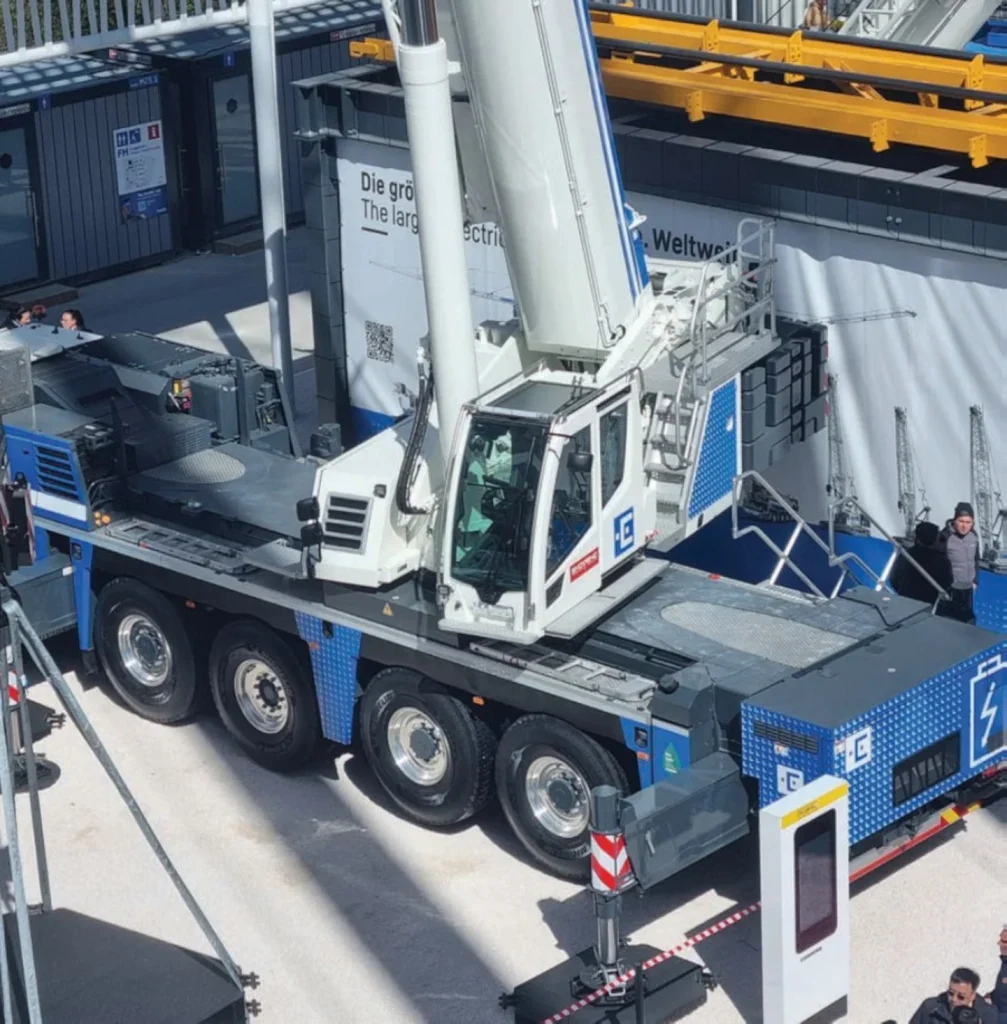
The 99 kWh battery is securely installed in a box weighing around 1.5 tonnes at the rear of the crane. To enable driving on public roads, the ballast plates have been adapted accordingly.
On- and off-road a 400kW (544hp) combustion engine with exhaust emission Stage 5 provides the drive.
The motor is fully compatible with hydrogenated vegetable oil (HVO) and, compared to diesel fuel, reduces operational CO2 emissions by up to 90 percent.
In crane operation users have a choice between using the combustion engine or electric motor. The latter reduces both air and noise emissions and is suitable for zero emissions areas and noisesensitive areas, says Liebherr.
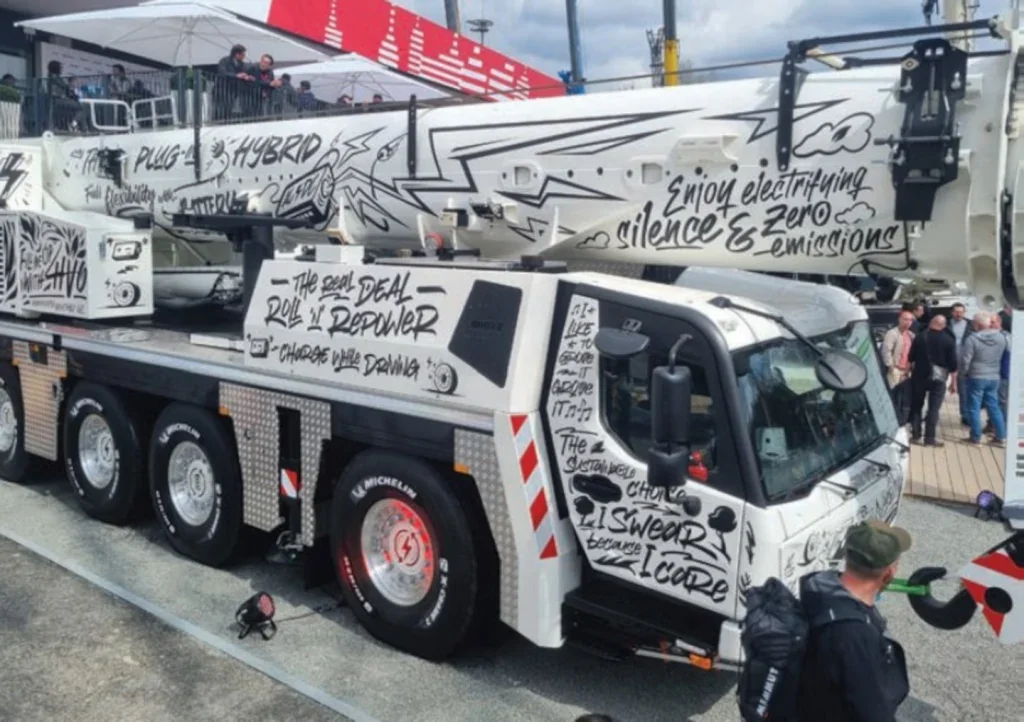
The 111kW electric motor for lifting offers virtually the same performance as the six-cylinder combustion engine as found on its sister model, the diesel LTM 1150-5.4.
For the transfer of power to the consumers in the crane superstructure the electric drive uses the existing gear shafts from the transfer gearbox in the chassis to the pump transfer gearbox in the superstructure.
The electric motor’s distributor gear is integrated between the chassis transfer gearbox and the gear shafts to the superstructure. This facilitates ease of switching between diesel and electric power, says Liebherr.
TWICE AS NICE
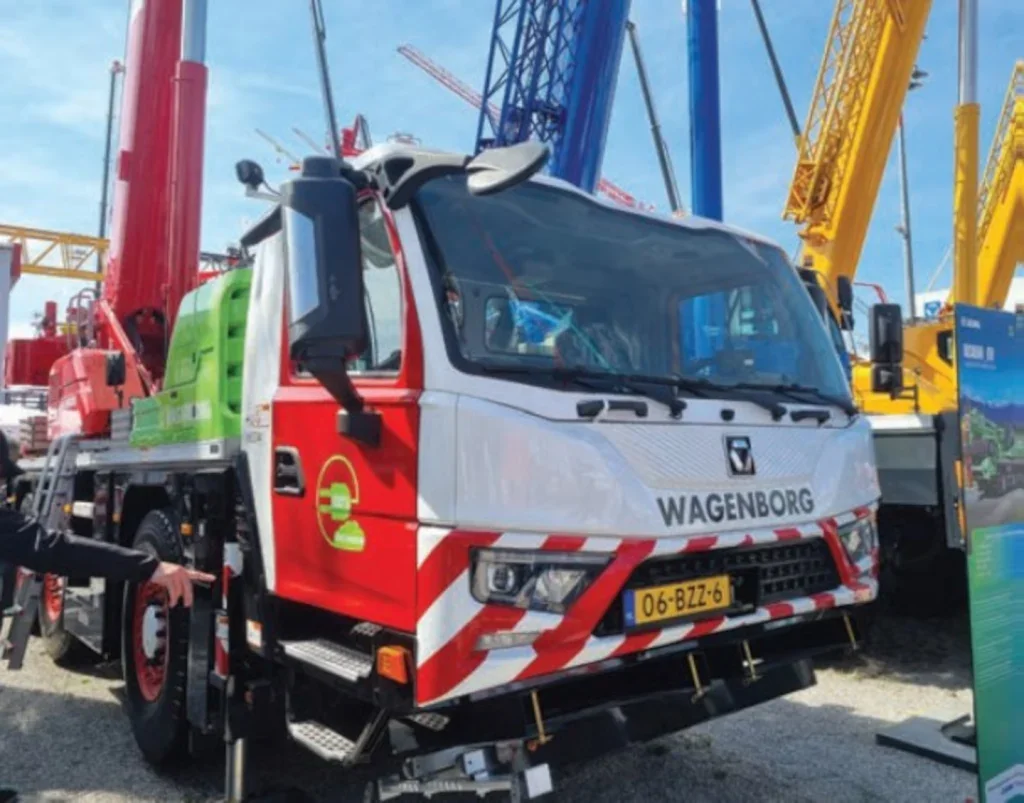
Manitowoc also used Bauma to launch its ever plug-in hybrid technology all terrain cranes: the 150-tonne capacity Grove GMK5150L-1e and GMK5150XLe.
The cranes incorporate much of the technology that was shown in concept form at Bauma 2022 in the GMK4100L-2 hybrid.
The cranes’ battery pack provides around 180kWh of energy enabling them to provide around five hours work as a taxi crane. The battery can be charged either from the grid (by AC or DC power supplies) or via a 170kW generator integrated into the carrier.
Charging whilst driving or using the crane is possible driving. When the crane is connected to the grid crane operation can be extended to approximately 20 hours without compromising speed or capacity.
“We certainly believe we have the best overall hybrid crane solution,” says Florian Peters, senior product manager for all terrain cranes at Manitowoc. “We say this because we offer the flexibility to charge the battery pack either from the grid (with either AC or DC supplies) or through the built-in generator, removing any concerns customers have about charging infrastructure.
“So if there is no charging infrastructure at the customer’s depot or on the jobsite, the journey to and from the project can still be used to recharge the 180kWh battery pack.
“The battery pack can accommodate a full working day without any compromise in performance. Even if the crane handles several jobs a day, recharging is unlikely to be required at the jobsite. And if grid charging is available at the jobsite, the crane can operate while being charged.
“When connected to a DC fast charger it takes around an hour to reach a full state of charge. If the internal generator is being used for charging it also takes around an hour to get to 100 percent charge. We should also note that the crane’s diesel engine can also be run on HVO fuel, which offers CO2 emissions reductions of up to 90 percent compared with traditional diesel fuels.
“When connected to 400V/32A power supply, the battery pack can charge overnight and be at 100% by the next morning. The crane can also work while charging with no impact on performance. With a full battery pack and if connected to the grid with a 32A supply, the crane can work for around 20 hours emissions-free. This kind of performance ensures the crane can handle all tasks in a day on even the most demanding jobsites.”
For more on Manitowoc’s new hybrid all terrains see the all terrain crane feature, and interview with Florian Peters, in our April 2025 issue: https://shorturl.at/zEFAd
COMING TO THE UK
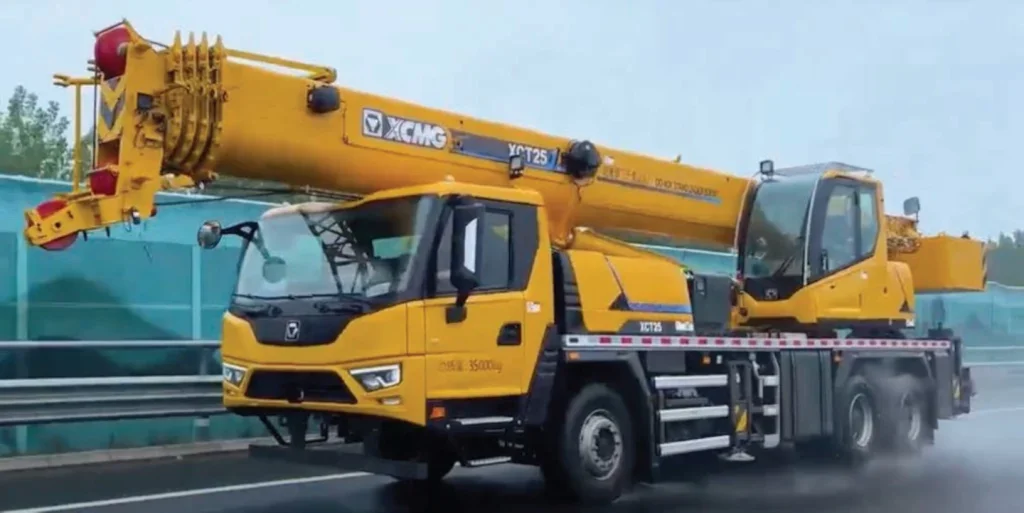
Another hybrid all terrain on display at Bauma 2025 was the XCA60_EV from Chinese manufacturer XCMG.
The three-axle crane has a maximum lifting capacity of 60 tonnes and its six-section boon has a maximum length of 48 metres, a maximum hoist height of 63 metres, and a maximum radius of 44 metres.
The crane, along with its diesel counterpart – the XCA60_E, is already available in some parts of Europe and North America. They will both become available in the UK later this year.
XCMG claims it as the world’s first hybrid all-terrain crane certified with both CE and WVTA in Europe. It has three working modes: pure electric, pure fuel, and plug-in hybrid.
The hybrid has a 230kw Mercedes diesel engine and a 170kW electric motor which XCMG claims reduces fuel consumption by around 40 percent.
The battery is integrated into the crane’s counterweight.
This hybrid crane recharges its batteries while driving and braking. This means that it can arrive at the site with fully charged batteries so that the operator can get straight to work.
Since Bauma XCMG has also launched a pure electric truck crane: the XCT25G5_1EV. It is an update of the XCT25_ EV which first launched at the end of 2021.
The crane has a 42-metre, five-section boom and a new electro hydraulic control system which XCMG says provides tangible improvements in simultaneous movements and the fine control and smoothness in lifting operations.
It has a maximum travelling speed of 90km/h and can tackle slopes up to 45 percent.
Acceleration from 0-50km/h has increased by 40 percent on this crane, says XCMG, claiming it feels more like driving a car than a crane.
The driver’s cab includes an air suspension seat, electric heating and cooling and a multi-functional steering wheel, plus a 12-inch LCD instrument panel and 10-inch central control display.
The electric crane is quieter in both driving and operation and can work continually for two shifts under pure electric operation, says XCMG. Charging duration (SOC 30-80 percent) takes just 30 minutes and it can be fast charged using a high voltage connection. A 96.2kWh smart charging unit can be specified. The crane has a waterproof rating of IP68.
A video of the crane can be seen here: www.youtube.com/watch?v=giKLrpKpwhM
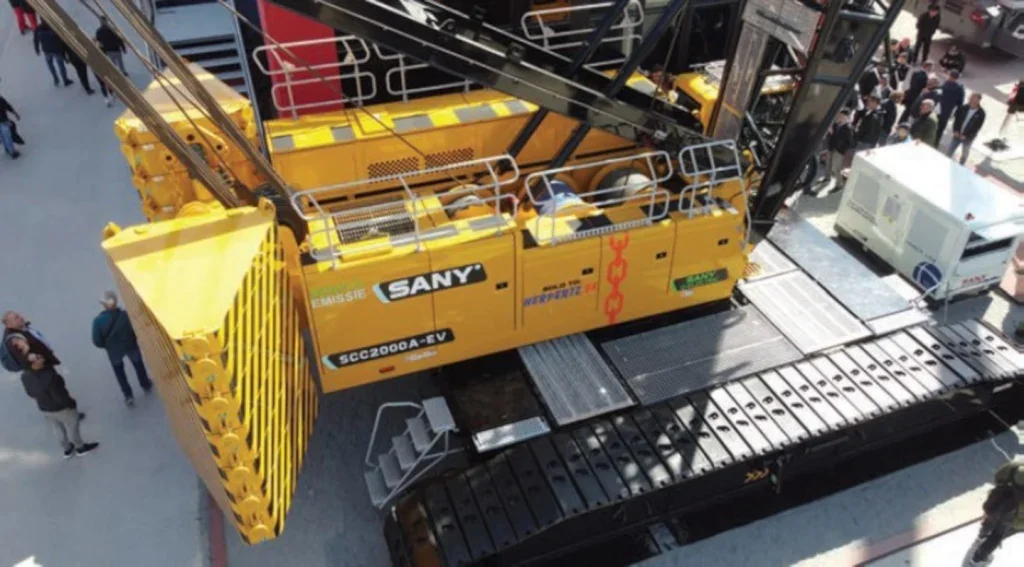
Another Chinese company, Sany, had a new large electric crawler crane on its stand: the 200-tonne capacity SCC2000A-EV. It is the first model in Europe and has been sold to Nederweert, Netherlands-based crane and transportation company Herpertz by Sany’s dealer for Europe, Netherlands-based company Sanycranes.services/UCM Holland.
The crane has an 86 metre main boom, a 30 metre fixed jib, a 63 metre luffing jib, and a maximum lifting moment of over 1300 tonne metres.
It is powered by a 422.87kWh high-capacity battery and a motor with a rated power of 234kW, a rated torque of 1118 tonne metres, and a peak torque of 2125 tonne metres. This, Sany claims, offers powerful performance and a runtime exceeding eight hours.
It supports AC/DC multi-mode charging with real time monitoring and protection against overheating, overcurrent and leakage.
It also enables European standard double-gun DC fast charging and can be fully charged in just two hours.
The eco-friendly electric drive also eliminates engine maintenance, adds Sany.
The crane has a working width of 7.5 metres to provide enhanced stability. The crane’s chain type flat track pads are designed to handle sandy, muddy and gravelly conditions, Sany says.
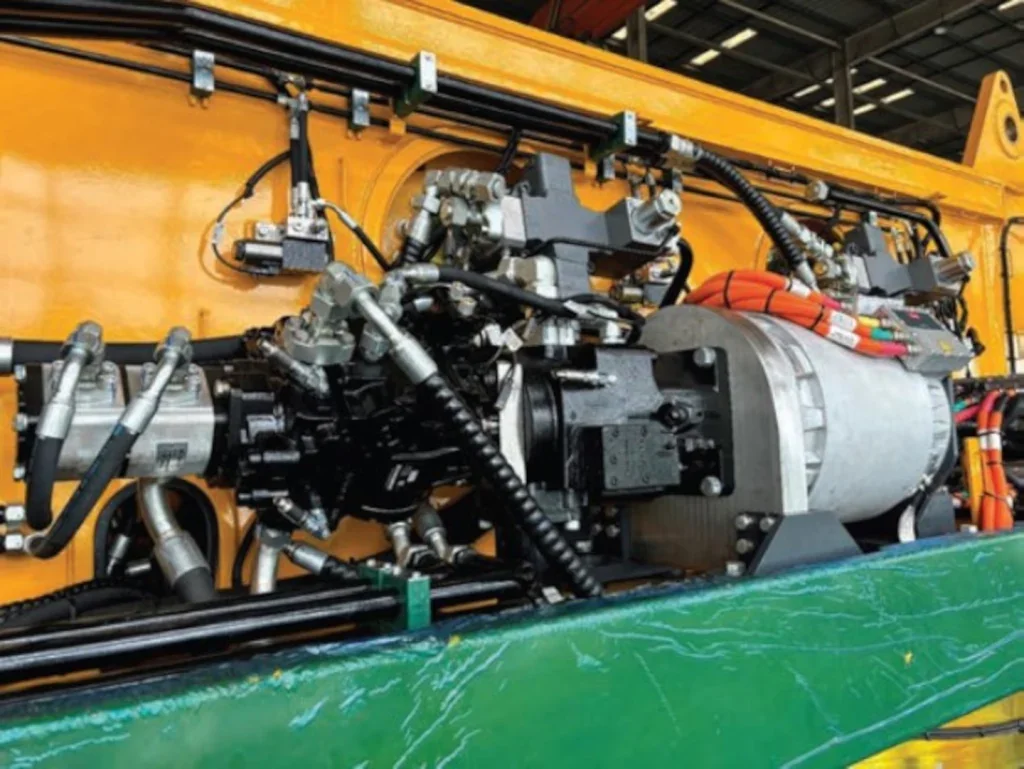
The crane’s battery is from CATL. The hydraulic motor and reducers are from Rexroth. And the electric motor and main valve are from Danfoss. Danfoss Power Solutions’ Editron division delivered its first eHydraulic Power Module for the crane. The eHydraulic system integrates a Danfoss Editron synchronous reluctance assisted permanent magnet motor with a Danfoss variable displacement axial piston pump to maximise performance and efficiency.
Comprising an Editron PMI375-T1100 motor and D1P 260-cc pump, the system is optimised to deliver peak performance and maximise hydraulic system efficiency, says Danfoss, extending machine runtime on a single charge. The full hydraulics system also includes a Danfoss Series 90 pump and PVG 128 valve.
The crane is also equipped with a centralised lubrication system designed for easier and more efficient maintenance.
The SCC2000A-EV can be operated via a wireless remote control system, enabling operators to control crawler travel, lifting operations and outrigger positioning, and rear counterweigh self-assembling.
The crane has a newlydesigned cab equipped with a suspension seat and a dual 10.1-inch smart touchscreen. The screen can supply split views of the surrounding area, winch monitoring, and zoom camera of the boom or jib head (allowing real-time awareness of the equipment’s surroundings).
For enhanced transportability, the boom segments have a ‘threein- one’ transport feature which Sany says greatly lowers transport costs. A YouTube video of the crane can be seen here: www.youtube.com/watch?v=jr5jlhhjxVk
SANY SALES
“We’ve sold 60 new Sany crawler cranes (lattice and telescopic boom) in the last five years,” says Jack Donker from Sanycranes. Services/UCM Holland. Donker has multiple roles at the company encompassing sales and customer liaison to ensuring all paperwork is EU compliant. “We have Sany customers across Benelux, UK, and Poland – those are the main countries we serve,” he continues. “Being in Western Europe our market is mostly electric these days. In the last two years we’ve only sold one diesel model for a customer who wanted to upgrade his Sany Stage 5 diesel crane to an electric model.
“The cranes we have here on the stand are all electric. It’s our main market and being able to supply a portfolio of electric cranes really helps us stand out in the market.”
On the Sanycranes.Services/ UCM Holland stand was a 50t capacity electric telecrawler (bought by foundation specialist Van Thek) and a 200 tonne electric lattice boom crawler (which, like the SCC2000A-EV, had been bought by Herpertz.
“Most of our customers are already on their fifth, or sixth Sany crane – that’s really nice to see,” concludes Donker. “And because there’s not been many electric options in the all terrain crane sector we’ve seen crane companies using electric crawlers instead. In this way the electric crawler market has cut into the mobile crane market a bit.”
CITY CRANE
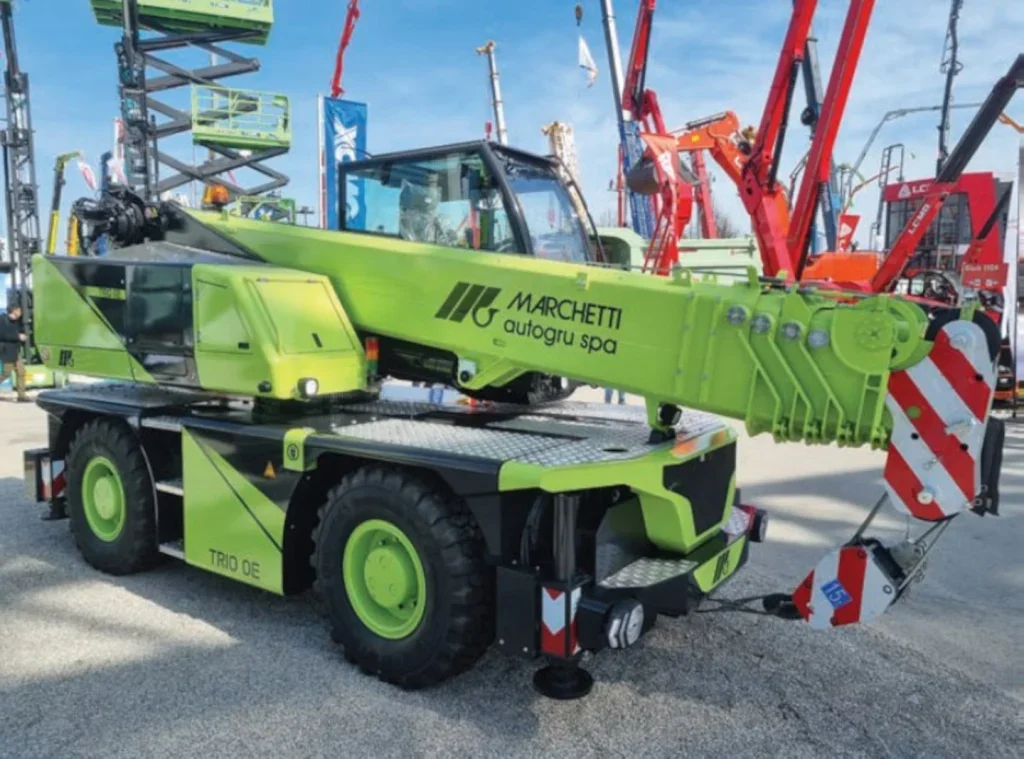
Another new electric crane on display at Bauma 2025 was the Trio OE Mini City Crane from Italian company Marchetti. It is powered by two rechargable LifePO Lithium batteries. The crane is compact, measuring 6.1metres long, two metres wide, and 2.9 metres high.
It has a hydro-pneumatic suspension system and permanent 4×4 traction for enhanced stability and manoeuvrability. It has a maximum speed of 40km/h
Three steering modes are available (road, concentric and crab). The crane also has a pick and carry mode which allows movement at speeds up to 5 km/h.
The crane has a lifting capacity of 15 tonnes and a total weight of 14 tonnes. The five-section telescopic boom extends from 5.2 to 19.1 metres. It can reach a maximum height of 21 metres.
At Bauma the crane was displayed alongside Marchetti’s electric CW25.35HY 25 tonne capacity battery-powered telescopic crawler crane.
ELECTRIC CRAWLER LINE
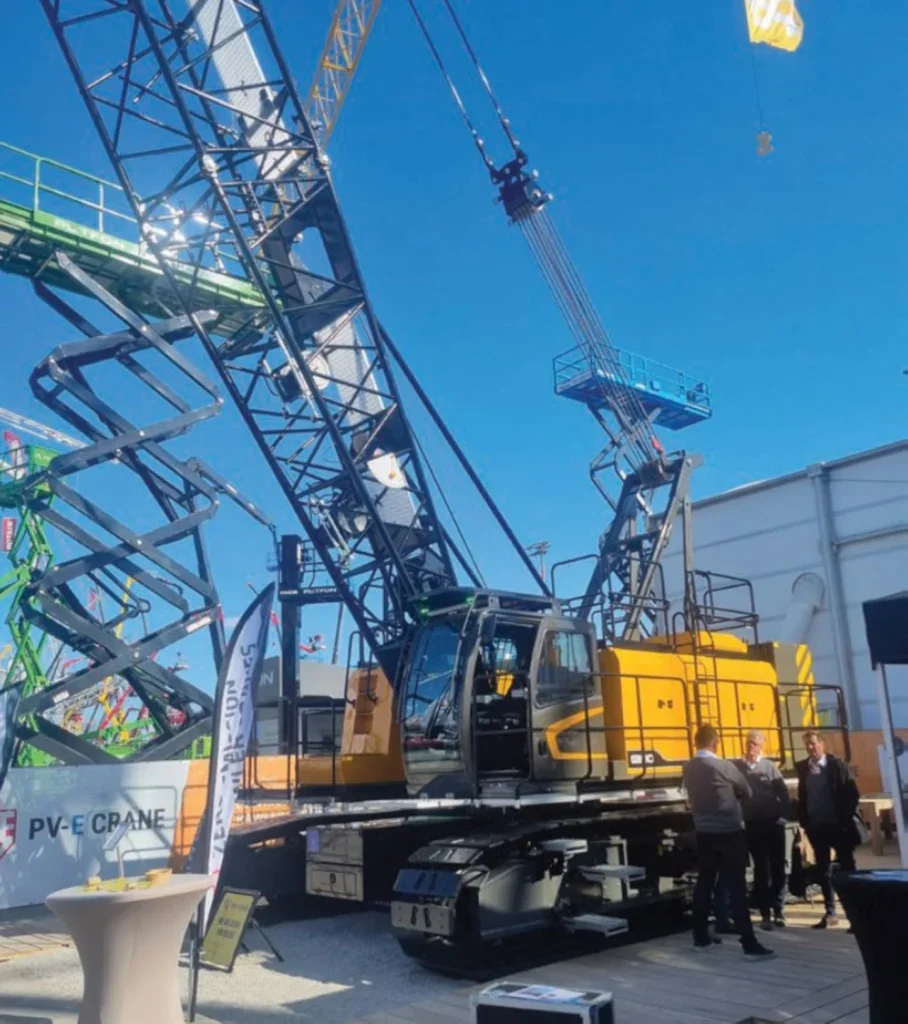
Oosterhout, The Netherlandsheadquartered crane manufacturer PV-E Crane used Bauma 2025 to showcase its EC series of electric crawler cranes, represented by the newest model on the stand: the EC90.
The series now comprises the EC80, EC90, EC135, EC160, and EC300 (with the numbers reflecting the cranes’ maximum load capacities). At Bauma PV-E Crane revealed it had already sold an EC90 to a Dutch contractor and said that the range had been well received by potential customers from Europe, USA, Canada and the Middle East.
“What we’ve done is to focus on increasing the quality of our cranes and the technology inside them,” says Joost Bomer, owner at PV-E Crane. “In this way we are positioning ourselves as a premium European electric crane maker.“
The EC series cranes all have new, more spacious cabins that are designed to provide more visibility all-round. In the cab is a large touchscreen display where everything can be read and controlled by the operator, while the cranes’ control joysticks are integrated into the cab’s ergonomic seat. The seat itself includes seat heating and optional massage mode. The seat can be adjusted completely independently of the control levers. The lower screen can be adjusted so that the operator will always be able to reach them well comfortably.
The cranes’ batteries can be charged whilst working via the undercarriage as standard. AC charging and DC charging (fast charging) also come as standard.
The undercarriage has been completely renewed and equipped with elastomer tensioners, while there’s also remote control for wireless operation of the crane during assembly.
“This crane here, for example,” continues Bomer, pointing at the EC90, “is fully CAN Bus controlled and offers a 360-degree camera view, the same quality as you would get in a car.”
The crane control software was developed in conjunction with Da-Tek Engineering.
“All our electric cranes are built from the ground up inhouse in The Netherlands. This enables the freedom for a degree of customisation, if the client requires,” adds Bomer.
ELECTRIC TO DIESEL
In an interesting move, from July 2025, PV-E’s range of EC cranes are available as diesel versions, using clean technology from Cummins. “The reason for this is that the scale of adoption of fully electric cranes has not been as fast and widespread as we initially thought,” explains Bomer. “We have already supplied early adopters and the government is talking a lot about going green but there is no enforcement of this…
“What we are seeing is some contractors bidding on emissionsfree work but then, once they have the contract, they bring in diesel machines. And there is no enforcement of this.
“This has led to a stalling of the market and we see crane buyers undecided between buying an electric model or clean diesel crane. This that led us making the range available as a clean diesel option, for the time being at least.”
The availability of the EC series as clean diesel cranes also appeals to potential USA based customers. “We have received our first preorder from our US dealer Ashland, Virginia-based Atlantic Coast Cranes,” says Bomer.
Last, but by no means least, Dutch company Spierings, a pioneer when it comes to electric cranes, launched a new five- axle eLift mobile self-erecting tower crane at Bauma 2025: the SK1265-AT5 eLift.
Spierings introduced the eLift series in 2020 under a ‘one man, one job’ principle. Thanks to the use of Spierings’ PowerPack technology, eLift cranes can operate fully electrically during daily operations, with a minimum energy requirement of just 16A or 32A. If no power connection is available the crane can operate stand-alone on battery power (hybrid mode). With eLift, you can save up to 85% fuel and still operate at full capacity and speed, says Spierings.
When the battery is low, the generator automatically starts charging the battery. With the automatic start/stop system, fuel consumption is reduced to less than two litres per hour, compared to seven litres per hour for a conventional crane.
By combining operation in 40% electric mode and 60% hybrid mode, the new eLift achieves up to 85% fuel savings. This equates to a reduction of 200.000+ kg of CO2 and offsets 17.000+ trees within 10 years, the company claims.
The crane has a maximum load capacity of ten tonnes (at 13.2 metres) and a tip load of 1.7 tonnes. Jib length is up to 60 metres and the height under jib is 40.5 metres – with a maximum lifting height of 64.2 metres.
Setup is fast at just 11 minutes. The tower can be set up to either 27 or 37 metres while the crane’s jib, with 30-degree capability, can be operated from the crane cabin or via the electrical cabinet.
Spiering’s advanced ballast steering technology facilitates the fast switching between different configurations without the use of an additional crane.
The crane is shod in Michelin X-Crane tyres (445/75 R22.5-inch), while air-conditioning in the crane cab, a steel toolbox at the rear of the truck, 4 steel pads (2.000 x 900 x 76mm) with an auxiliary crane arm and a 30 metre charging cable all come as standard.
Spierings is positive about the current state of demand for electric cranes in Europe. “At Spierings Mobile Cranes, we see a clear and growing demand for electric and sustainable lifting solutions across Europe,” says Herald Wattenberg, commercial director. “We are convinced this trend will only continue to rise in the coming years. That is why we have made a clear choice as a manufacturer: we only manufacture hybrid cranes since end 2023, taking a firm step toward a zero-emission future. The proof is in the pudding as Spierings has delivered over 300 eLift Spierings Cranes till date and each week increasing this number.”
The ‘green machines on display at Bauma demonstrate the breadth of innovation from manufacturers and the rapid rate of progress being made in the electrification of lifting. These next generation cranes show impressive gains in energy efficiency, performance and versatility – with many now capable of operating for full workdays on battery power alone, with fast charging and hybrid helping ease the transition. Although the market still faces challenges, with regulatory uncertainty and inconsistent enforcement slowing the rate of adoption, there remains strong demand in Europe and the continued investment in electrification shows that hybrid and electric cranes are not just a trend; they are shaping the future of lifting.


