
Mini cranes reach the places that other cranes cannot go. They can manoeuvre themselves inside buildings, through narrow doorways, under low roofs, even up narrow stairways of domestic buildings (see the video at https:// bit.ly/45B5ngW where a Befard XM 800 mini crane does exactly that!).
Mini cranes are adaptable: church bells, office facades, art installations in shopping malls can all come within their remit.
Customers are becoming wellaware of their advantages and manufacturers are responding with expansions, updates, and new introductions.
Last year’s Bauma and GIS tradeshows saw several new launches. Unic Cranes Europe, for example, announced the launch of its four tonne, all-electric, lithiumion battery-powered UM445 mini spider crane at Bauma. The crane’s main boom lifting capacity is 4,000kg; its lifting height is 11 metres; and it has a working radius of 9.8m. It has pick-and-carry capability, to boot.
The hydraulic tele-luffing jib has 1,500kg lifting capacity, a 170° working range, and an extended maximum lift height of 17.5m, alongside a working radius of 15.6m. A Scanreco radio remote control with colour graphics and real-time data helps provide accuracy and control.
Unic Cranes Europe also launched the Unic URW-806-3 mini spider crane – a successor to the Unic URW-706-2. It has an eight-tonne maximum lifting capacity, an updated hydraulic tele-luffing jib, Scanreco colour screen remote control with full feedback, and a variable footprint system. It is also compatible with Unic Cranes Europe’s new Lithium Unic ECube system.
The new hydraulic tele-luffing jib has a working length of 3.8m – 7.5m (configuration dependent), a 27.8m lift height, and a maximum working radius of 21m.
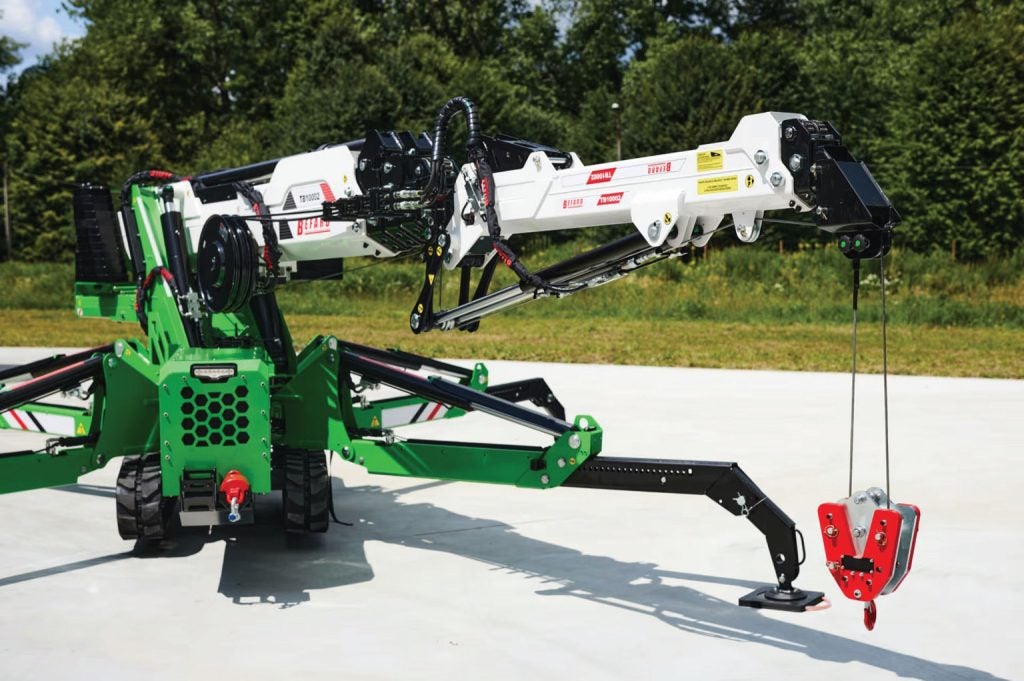
Bielsko-Biała, Poland mini-crane manufacturer Befard (which stars in the video we mentioned earlier) introduced its latest addition, the Befard TB10002, at GIS.
Designed to be compact (at 4.10 x 0.79 x 1.96m) but tough and capable, its intended customer base includes construction, glazing, industrial, and installation companies. Maximum load is 6,000kg with pick-and-carry capability up to 1,800kg, with an extendable counterweight.
Power options include diesel, electric, and Li-ion battery. Other features include full radio remote control, hydraulic winch, jib extensions, extendable outriggers, and continuous slewing.
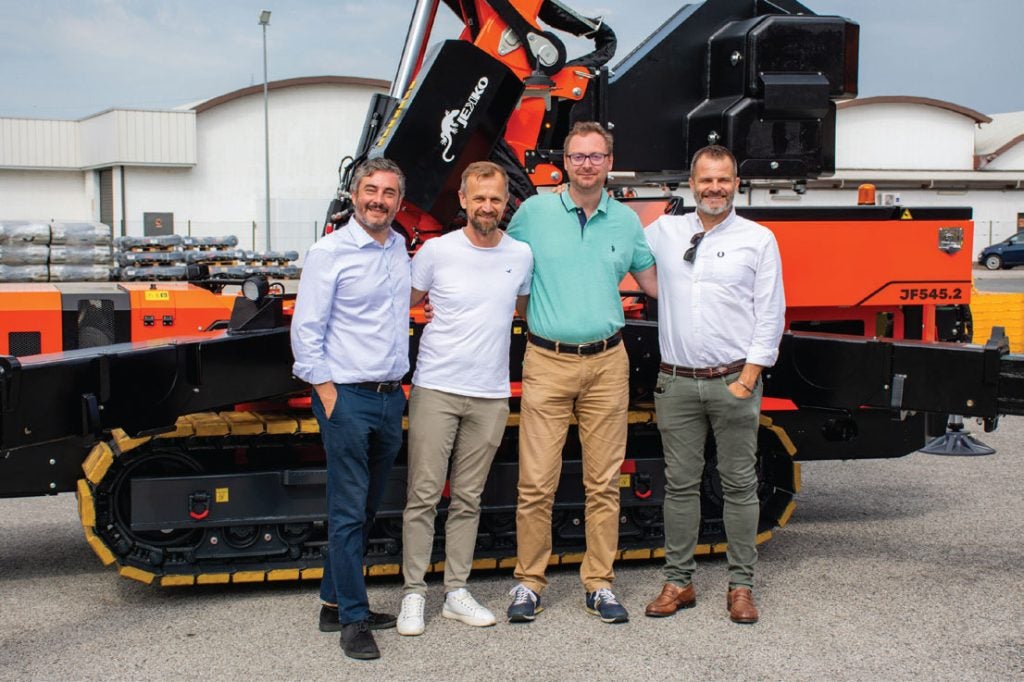
Jekko’s contribution is the SPX532.2, which appeared at both shows. It’s an evolution of its bestselling SPX532. It has a 3.2 tonne lifting capacity, a maximum height of 17 metres, and it’s available in a full electric version powered by lithium-battery or a bi-energy version with a diesel engine combined with an electric powerpack.
NETWORK EXPANSION
Jekko has been expanding its reach in other ways: we’re speaking, here, of distributorships rather than boom lengths. Based in Treviso, in the engineering stronghold that is northern Italy, the company is working to increase its global-wide network, with major developments in South Korea, Greece, Switzerland, the Czech Republic, the UK, and Germany.
In Goyang-si, South Korea, Jekko signed a sales, servicing and consulting dealership agreement with KoWu (a subsidiary of the Kilwoo Corporation – a well-known name in the South Korean market specialising in the supply and distribution of heavy-duty lifting, construction, transportation, and measuring equipment).
Established in 1980 the company also serves as an exclusive distributor for globally renowned brands, including HSC, Link-Belt, Konecranes, and Sennebogen.
“We see a strong market potential in South Korea, especially in areas tied to urban redevelopment, smart cities, infrastructure, and green building technologies,” says Marco Piccin, Jekko sales manager. “Jekko cranes perfectly fit with these needs, with the widest range of battery-operated minicranes ideal for indoor operation and compact units for tight urban jobsites.
KoWu Corporation has the right market knowledge to help the Jekko brand to deeply penetrate the market”.
In December 2025 Jekko announced the appointment of Arsis as its new official dealer for Greece. Arsis is the official distributor for Fassi loader cranes in Greece, so is already specialised in the trading, repair and installation of hydraulic cranes and has a well-structured and technically skilled organisation that delivers pre- and post-sales support across the country. “We place great value on working with partners that have technical competence and a structured approach to customer support,” says Alberto Franceschini, sales director at Jekko.
Arsis will distribute the full Jekko range, spanning SPX mini cranes (2.8–8 tonnes), JF articulated cranes (6.1–21.5 tonnes), and MPK mini pickers (0.6–5 tonnes) – as well as the TRX truck-mounted mini crane and the JCX telescopic crawler crane.
In September Jekko announced Mobas as an exclusive dealer for Jekko brand in Switzerland.
Founded in 1963 and headquartered in Wil, Mobas is a leading provider of lifting solutions and vehicle construction. With branches in Wil, Root, Harkingen, Grosswangen, and Echandens, the company combines sales with a strong nationwide service network, offering maintenance, repairs, spare parts, and warranty support, says Jekko.
In the same month Jekko also announced the appointment of PM CZ as its new official dealer in the Czech Republic. Jekko says the partnership reinforces its presence in central Europe, ensuring local customers benefit from dedicated sales support, aftersales service, and access to the full range of Jekko products.
Jekko has also launched a new UK division. In collaboration with UK crane dealer Foster Cranes, in May, it launched a company dedicated solely to the sale and service of Jekko cranes in the United Kingdom.
Foster Cranes has been the exclusive dealer for Jekko in the UK since January 2024. “Jekko cranes have been such a success in the UK that we are expanding our business,” says managing director Andrew Foster. So Foster Cranes established Jekko Cranes UK dedicated exclusively to the Jekko brand. The new division is headquartered in Kidderminster where it operates sales and technical pre-sales and after-sales offices. It has a fully-equipped workshop to support its operations and customer service and a warehouse stocked with ready-to-ship cranes and spare parts.
Foster Cranes also helped Jekko spread its reach by opening a new facility in Kent to cover the south of England.
The new facility has a sales office, a product warehouse, and a post-sales workshop. “We’ve created a new division, opened a southern hub, and expanded our team to fully support the brand. Jekko Italy is a fantastic business – its innovation centre is constantly expanding the product range. We want to fully support its ambition to continue to be the market leader,” says Foster.
NEW MARKETS
In Germany Jekko has partnered with the (CCR), a leading research hub within the Construction Cluster at technical university RWTH Aachen.
The first project they worked on was called the MAXX project and it was showcased at Bauma 2025. It is a revolutionary system combining mini cranes with industrial robots which promises to transform building renovation work. Jekko and CCR developed the system along with German robotics company Kuka and with Fundermax, who make facade panels. It claims it could revolutionise the refurbishment of building facades. Scaffolding will no longer be required; nor will the skilled craftsmen who are currently in very short supply.
Jekko says that MAXX will also increase speed and safety, and opens up the €400 billion European refurbishment market to small and medium-sized construction companies.
MAXX stands for Mobile Assembly X. It is an automated ‘Plug and Produce’ system to attach facade elements to a building; it teaches itself to do so by machine learning, with minimal operator input and without the need for scaffolding.
The system consists of a Kuka industrial robot arm equipped with multiple sensors and with vacuum grippers. The robot is mounted on a framework platform which hangs from the end of the Jekko mini crane and works seamlessly with it; in fact, the robot controls the crane, via 5G and machine learning. The platform also carries a stack of panels.
The robot arm lifts the top panel from the stack using its vacuum grippers, lifts it into position on the facade of the building and secures it in place.
Fixing the first row of panels is controlled manually by the operator, through a tablet. The robot learns from that the panel size, the width of the openings they are to go into, and the motions required to attach them in place. It communicates those motion commands by 5G to the Jekko crane, guides it to the right position, and together they fix the next panel, and then the remaining ones, over the rest of the building all by themselves; no operator intervention is needed.
A custom gripper holds the robot firm against the building to stabilise it against wind forces. Once a row of panels has been fixed the robot communicates the starting position for the next row to the crane and prompts it to go there.
A key innovation is the robot’s automated learning. It means that the operator does not need to pre-programme anything; MAXX simply repeats and continues the assembly strategy that was first performed manually. No digital model of the building or robot path planning is required.
A second key innovation is that the Jekko crane is controlled throughout by the Kuka robot. The system is scalable to projects of any size, says Jekko.
STREAMLINING SERVICE
The Kranlyft Group is headquartered in Sweden, with subsidiaries in the UK, Germany and France. It serves customers across European, the Middle Eastern and African markets.
Last year it acquired a new CEO, Claes Johansson, who has formed a new organisation to streamline and improve customer service.
One specialisation of the company is mini cranes, being the master distributor for Maeda, plus Klaas aluminium cranes.
It launched new models at Bauma 2025, the Maeda MK3053C and the MC405-5, which it says represents the latest generation of knuckle-boom spider cranes.
The MK3053 has a compact footprint – 780 mm stowed, 1050 mm extended – which is narrow enough to fit through standard doorways. The main boom has a lifting capacity of 2.98 tonnes and up to 16.95 metres of reach.
Fully proportional wireless radio remote control and stepless multi-outrigger settings reduce setup time, as do semi-automatic boom/ jib stow and leveling functions.
Programmable safety systems include moment limiting, working limits, and data logging.
Optional telematics (M Link) and auxiliary battery units are designed to extend uptime and allow fleet monitoring and diagnostics to boost efficiency in urban, industrial and rental applications.
The MC405-5 can lift 3.83 tonnes at 2.7 metres. Its maximum working radius is 16 metres, at which length it can lift 0.21 tonnes.
It has a maximum lifting height of 16.8 metres or, with the fly jib, 20.7 metres. The crane can be used for pick and carry duties with up to half-a-tonne on the hook.
Like the MK3053C, the MC405-5 also has multi-outrigger mode, digital radio remote control, a diagnostic display, and safety systems such as slew restriction and programmable moment limiting. A front camera with LED lighting aims to improve visibility in tight job sites for both models. In July Maeda also expanded its network in Thailand by welcoming Tadano Siam as a dealer. Tadano Siam is located in Bangkok.
Another mini crane manufacturer, Dutch company Hoeflon, is actively expanding its dealer network, too.
Australian company MCT Equipment, based near Perth, Western Australia, is now stocking Hoeflon mini cranes. “We search the world for the best products, and Hoeflon represents the next level in tight-access lifting,” said Anthony Grosser, managing director of MCT Equipment. “Their design and capabilities make them ideal for the challenging environments our clients face.”
While, in Switzerland, Bischag, based in Laufen, is now an official Hoeflon dealer and service partner.
With over 50 years of experience in lifting technology, transport, and technical services, Bischag offers the complete Hoeflon product range and full after-sales support throughout Switzerland.
In June 2025 Hoeflon appointed Benjamin Beelen as general manager after Gert van Hoef, founder and owner, handed over some of his responsibilities (although he will remain actively involved as technical director).
Hoeflon says it has experienced strong growth in recent years. With the expansion of our production and team, a brand new location and continuous innovations, Hoeflon believes the appointment of a new GM is a strategic step to continue this growth in a sustainable way.
Like many of the other companies mentioned in this article Hoeflon is also innovating with its product range. Its Hoeflon C6e Gen 2, for example, features an overall new design, including new lighting, a removable counterweight with integrated storage compartments, protective covers over the sensors and removable outrigger pads mounted directly on the outrigger feet. Hoeflon says these design improvements aim to enhance usability and visibility, while giving the C6e Gen 2 a clean and robust appearance.
So we see the mini crane sector is no longer a niche sideshow to ‘real’ lifting equipment. As machines become more capable, cleaner, smarter and easier to deploy, they are increasingly the first choice rather than the last resort.
Whether it is squeezing through a doorway, working indoors on battery power, or partnering with robots to transform facade refurbishment, mini cranes are proving that agility, innovation and efficiency often beat brute force. In lifting, as in so much else, smaller can be smarter.


