

The global rough terrain (RT) crane market continues to evolve as manufacturers respond to shifting customer demands. Around the world rough terrain fleets are being renewed, older workhorses replaced, and new technologies are reshaping expectations of what a rough terrain should deliver.
This article brings together insights from experts and leading OEMs (Link-Belt Cranes, Raimondi, Manitowoc, Liebherr, Tadano and XCMG) highlighting new machine developments, portfolio strategies, and how manufacturers see the future of the rough terrain segment taking place.
Link-Belt Cranes
Those attending the ConExpo tradeshow in Las Vegas are in for a treat as there will be a new rough terrain crane from Link-Belt Cranes on display. “We’re going to have a little surprise at ConExpo for our visitors and customers,” reveals Kelly Fiechter, product manager for rough terrain cranes at Link-Belt. “We’re going to introduce a new 90-ton rough terrain crane: the 90|RT 2.”
The 90|RT 2 is the nextgeneration model of Link-Belt’s popular 90-ton RTC-8090 Series II. “Our RTC-8090 Series II has been a very popular crane for us,” explains Fiechter. “But many are of an age where they are starting to exit service life. So we decided to introduce this 90|RT 2 so that our customers and our fleet owners could have something to replace them with.”
Fiechter is excited about the new crane. “We’re excited to continue the lineage of what was that RTC- 8090 Series II,” he says. “The 90|RT 2’s specifications all fit the same market that was occupied by the RTC-8090 Series II but it’s going to have all the modern features that our current RT series brings.”
This means that the 90|RT 2 has a 38–140-foot, five-section pin and latch formed boom. Two optional 16-foot boom extensions and a 35–58-foot bi-fold SmartFly give the 90|RT 2 a maximum tip height of 239 feet. Its winches deliver 23,632 pounds of line pull and 393 feet per minute of line speed.
The greaseless boom includes Link-Belt’s standard Teflon wear pucks and removable modular counterweights — up to 28,800 pounds – reducing transport weight to under 91,000 pounds.
The 90|RT 2’s six-speed transmission is powered by a dual-compliant Cummins Stage V/ Tier IV QSB 6.7L 232-horsepower diesel engine.
Four 29.5X25 tyres, mounted on axles, affix to the carrier via greaseless four-link suspension, eliminating ten previous grease points.
A 24-volt electrical system, remote-mounted filters, and easy access fluid checks are designed to facilitate routine service.
“The 90|RT 2 boasts a very strong chart with no deducts in the lift chart when telescoping a load,” says Fiechter. “This is going to be a great crane that will continue to serve the needs of our RTC- 8090 customers. They’ll enjoy all the modern conveniences of our current RT series (Pulse 2.0, V-CALC, cameras, fall arrest) going into this tried-and-true class of crane.”
As well as the company’s new crane Fiechter is also positive about the state of the RT sector in the USA. “It’s very steady,” he says. We expect demand for our rough terrain products to continue, given their ease of mobility and intuitive operation. Products like the 85|RT and 100|RT remain a top choice among our customer base.
“In particular, we’re hearing about increased need from large-site construction projects – such as data centres, and power transmission. This is in addition to all the traditional types of work you’d rent a rough terrain for – at water treatment plants, in the mining sector, and heavy civil projects.”
Visitors to ConExpo can see the new 90|RT 2 on Link-Belt’s stand: Festival Grounds — F35029.
Raimondi And Terex
Also at ConExpo will be Italian crane manufacturer Raimondi with its newly integrated Terex lifting brands. ConExpo marks the first major showcase of Terex equipment following its acquisition by Raimondi.
Headed by Raimondi CEO Luigi Maggioni a delegation – including senior managers from Raimondi and Terex rough terrain cranes and tower cranes divisions, plus an North American support team – will showcase its latest developments and strategic direction in the outdoor exhibition area at Stand F18012.
“For the first time we are presenting ourselves as a unified Group now featuring the high performing Terex rough terrain range – a product line that brings a whole new dimension to our portfolio,” says Maggioni. “Our participation at ConExpo marks a step forward in Raimondi’s long-term growth trajectory and underscores our ongoing commitment to expansion in the US market.”
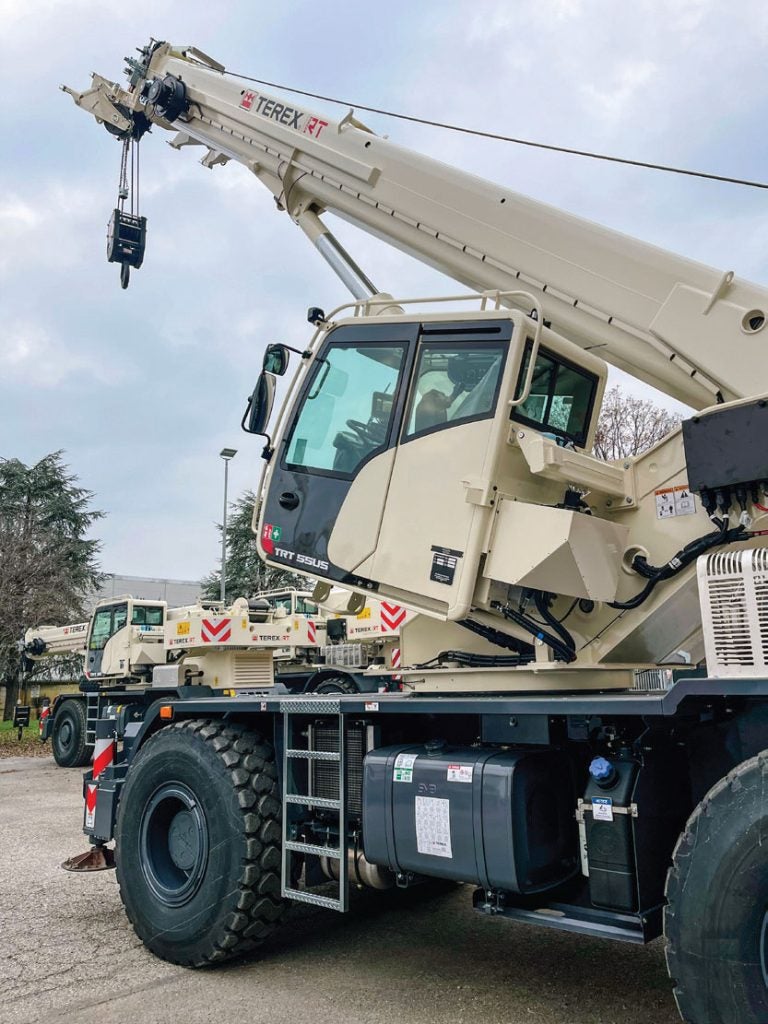
At ConExpo Raimondi will show the TRT 55US, which has been engineered primarily for the North American market.
Raimondi says the TRT 55US will stand as one of the central highlights of its ConExpo stand. Designed and developed in Italy by the Terex Rough Terrain team, and shaped by customer insights gleaned from the US market, Raimondi says the new 55 ton model builds upon the engineering foundations of Terex’s range.
The TRT 55US is compact in size. It’s been designed to facilitate transport, and has an additional jib configuration for versatility, plus a redesigned operator environment.
The crane’s 55t lifting capacity is supported by a maximum jib length of 122.7 ft, with three telescoping boom modes for enhanced operational flexibility.
The third mode, a distinctive feature of Terex rough terrain models, is the Proportional Telescoping Boom mode, designed to simplify operator workflows.
Reaching a maximum tip height of 130ft with the main boom, the TRT 55US may be equipped with an additional 26.25ft jib, thereby extending the maximum tip height to 157.5 ft for particularly demanding lifting applications.
Among its key advancements the TRT 55US offers optimised mobility for off-road conditions, improved load chart performance across the full working radius, and enhanced stability through upgraded control and monitoring systems.
The machine is engineered to support demanding duty cycles typical of energy, infrastructure, and industrial construction applications across North America.
“This model reflects a focussed engineering effort to align with North American performance expectations, safety standards, and application requirements,” says Andreas Ernst, president, Raimondi North America. “The new generation of rough terrains introduces a modern design approach built around high-quality components and advanced systems such as TEOS and T-Link, further elevating control, monitoring, and operational efficiency.”
Another key system integration is IdeaLift, which increases job site versatility by maximising the load chart through the use of asymmetric outriggers.
The TRT 55US marks the first product debut under the newly established Raimondi North America banner. With Raimondi North America the company says it is now positioned to offer a stronger, more localised, support network further reinforcing its intent to serve American customers with greater responsiveness and proximity.
“Being closer to our customers is a strategic priority,” adds Ernst.
“Our presence on the ground allows us to respond faster, support more effectively, and build long-term partnership based on trust, technical expertise, and service continuity.”
Manitowoc
Another rough terrain crane on display at ConExpo is the Grove GRT780. According to manufacturer Manitowoc it is one of North America’s most popular rough-terrain cranes. Visitors can see it on the Manitowoc stand: Festival Grounds — F39029.
Manitowoc says it has produced tens of thousands of Grove RTs over the years with many thousands working worldwide today. It currently has eight models its Grove GRT lineup – starting with the 40 USt GRT540 up to the 165 USt GRT9165. “This wide range of models allows us to fully cover the RT market, whether you’re doing municipality maintenance work, construction and infrastructure projects, utilities, dock work or working in the oil and gas industry,” says John Bair, product manager, rough-terrain cranes, Manitowoc. “The applications for RT cranes are quite extensive, so we want to ensure we provide our customers with the right size crane for their needs.”
According to Bair the Grove range of GRT cranes offers a blend of legacy features, such as reliability and strength, while also incorporating the latest tech needed for today’s market.
“The majority of our models are class-leading when it comes to capacities and boom length,” claims Bair. “Most importantly, however, these cranes need to perform reliably in the field and we have invested heavily to ensure our customers receive not only the highest performing RT crane in its class but also one that will keep working day after day, eliminating downtime and increasing their ROI.
“This is why we offer a standard two-year warranty on all our new GRT cranes, with the option to extend coverage to five years.
“Of course, we are always moving forward with new technologies to further improve performance and efficiency; some examples include our CCS control system, Full Vision cabs, and our MAXbase asymmetrical outrigger positioning system.”
According to Bair, another reason why customers continue to invest in Grove GRT cranes is the customer support that comes with them. “We offer a host of additional support services to help customers earn more with their cranes, via comprehensive parts coverage, technician support, training, Grove Connect telematics, and more,” he outlines.
Grove says its rough terrain cranes between 80 and 100 USt maximum capacity continue to see high demand in North America due to their versatility in being able to serve a wide range of applications.
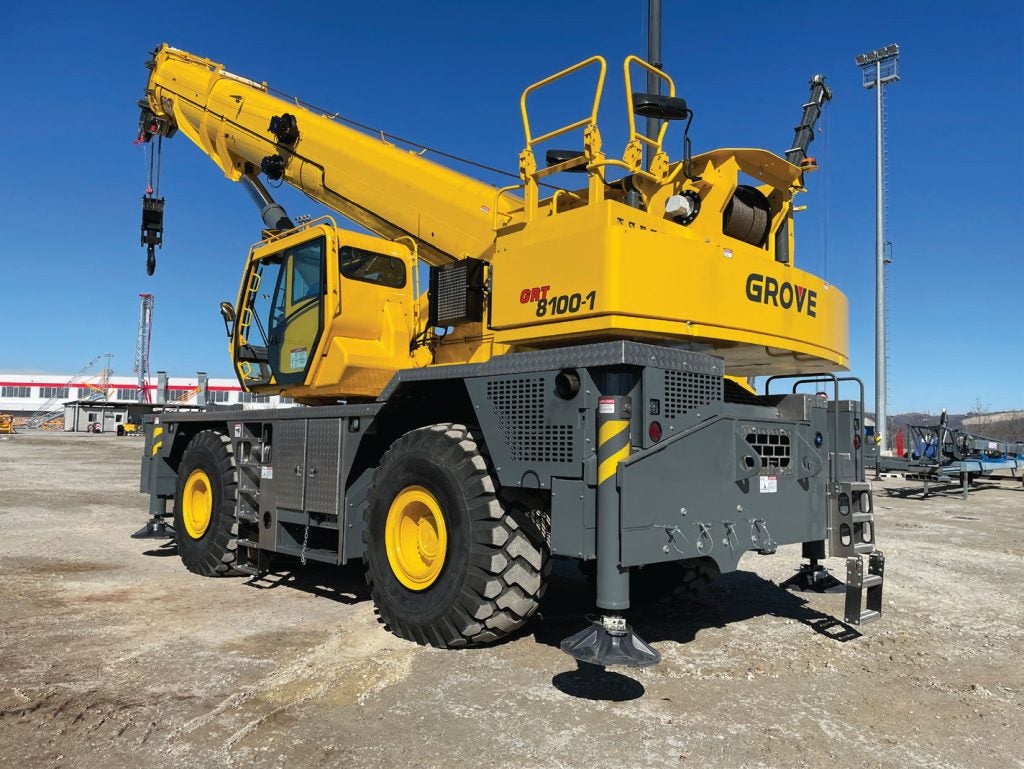
“Our GRT780 and GRT8100-1 are great workhorses and have been a huge success for us,” says Bair.
“One of our most recent launches, the GRT780, offers class-leading lifting capacities and a boom length of 155 ft. while also incorporating a compact chassis that allows for easy transportation and excellent maneuverability on site.
“The GRT8100-1, our 100 USt capacity offering, has been a staple in our line-up. It offers classleading lifting performance and has operator-centric features like our new wider full vision cab, a three camera package for increased visibility, 20° cab tilt capability, and our Crane Control System for simple, efficient operation.”
Grove recently introduced three new models to its GRT line-up. “They include the GRT540, GRT765, and GRT780,” explains Bair. “With these three introductions we’ve rounded out lower and mid-capacity classes in our GRT product line to include our Crane Control system along with a host of improvements when it comes to performance and reliability. All three cranes feature best in class lift capacities and boom length, along with our new 12-inch, touchscreen CCS display.”
Grove reports that market reception to the new models has been great. “We’ve talked to many customers who are impressed with not only the reach and lifting capacities of the cranes but also the boom controls, noting the smooth yet quick operating speeds,” says Bair. “In addition, customers are pleased with the new larger, touchscreen CCS display, MAXbase capabilities and optimised carriers that increase storage, 360° LED lighting, and accessibility for maintenance.”
North America remains the biggest and strongest market for Grove’s rough-terrain cranes.
“The RT market in North America looks to be strong as we head into 2026,” says Bair. “Infrastructure, energy, and utilities are driving demand for RT cranes. We are seeing high utilisation from fleets and demand for larger capacity RT models continues to grow.
Demand is, in part, being driven by commercial construction for projects such as data centres, warehouses and new factories.
“In addition, the oil and gas industry continues to drive significant demand for RT cranes as well due to their fast set-up, compact dimensions, and low operating costs,” adds Bair.
Other attributes of the Grove RTs that are contributing to their success are their technological and digital capabilities. “These are taking rough-terrain cranes to the next level in terms of productivity and efficiency,” says Bair. “All our Grove GRT cranes come equipped with our CCS operating system.
In addition to offering intuitive operation, CCS includes features that provide the operator with the ability to fine tune the crane controls to their liking by adjusting the sensitivity and speeds.
“For our Twinlock boom pinning models, we offer our Boom Configurator, which allows for on-board lift planning and simplification of the telescoping process.
“We’ve also introduced our Grove Connect telematics platform on our newest GRT models.
Connect provides easy access to your complete fleet in real time. You can view live crane activity, crane configuration, RCL data, GPS, faults, hours, and more.
“Customers are looking for predictive maintenance, better understanding of utilisation, as well as remote diagnostic capabilities.” Bair identifies another element customers are looking for. “The markets are showing growth to higher capacity; longer boom RTs.
So future RTs will need to continue to grow in those capabilities, while still maintaining compact and easily transportable designs that allow for fast self-assembly and durable performance.”
According to Bair, Grove expects the RT market in North America to continue to grow over the coming years. “Aging infrastructure contributes to this demand as we will see bridges, highways, airports, and water plants, needing upgrades,” he says.
“Not to mention the flurry of data centres and warehouses going up all over the country. Energy and utilities also continue to anchor the RT market as they will continue to drive and grow demand.”
Liebherr
Liebherr’s first involvement with the RT sector was in the 1980s to the mid-90s when it had the LTL range. The range comprised RTs with lifting capacities between 25 to 80 tonnes. Liebherr, however, was looking to further develop its range of all terrain and crawler cranes which were enjoying success in global markets. So it stopped RT production to use all its capacities to manufacture all terrain and crawler cranes instead.
In 2017 Liebherr returned to the RT sector with the launch of the LRT 1090-2.1 and the LRT 1100-2.1. The development of the new generation of Liebherr rough terrain cranes was preceded by extensive market surveys and analysis into the requirements for modern RT cranes, particularly in the main market of North America.
In addition to the capacity of the cranes, their safety, particularly their safety resulting from ease of operation, was one of the main focal points for the development of the new rough terrain cranes.
Since 2017 around 800 rough terrains have now rolled off Liebherr’s production line. The company says that, during this time, it has noticed a trend towards larger rough terrains. As a result, it says, it developed the 130 metric tonne LRT 1130-2.1 which launched at Bauma 2022.
For Liebherr safety is, and always has been, a key feature of its RT designs. “High safety standards are particularly essential for RT cranes,” says Wolfgang Beringer, marketing and communication at Liebherr. “They are often rented on a bare rental basis, i.e. without a driver. This means that they must be very easy to operate. Intelligent assistance systems must also be in place to support the driver. In our designs, we follow the ‘KISS’ principle: Keep it simple and safe.”
Liebherr offers three RT variants in its current portfolio: the LRT 1090-2.1; LRT 1100- 2.1; and LRT 1130-2.1. Liebherr says these cranes continue to meet its high levels of safety. “A very high level of safety defines our current RT portfolio,” says Beringer. “We deliver our RT cranes worldwide with 75% tipping load utilisation, which makes the cranes significantly safer than the 85% tipping load utilisation that is standard in the USA.
Liebherr’s RTs also come with VarioBase variable support system as standard.
The importance of transportability is another trend Liebherr has observed since its re-entry into the RT market. “We have developed solutions for flexible, economical transport specifically for our LRT 1130-2.1,” highlights Beringer, “because, for example, each state in the USA has its own transport regulations.”
Over the years Liebherr’s most popular model RT model has been its LRT 1100-2.1 although in 2024 and 2025 it was the LRT 1130-2.1. Liebherr says the LRT 1130-2.1 is the strongest RT crane on two axles worldwide. It’s the company’s most recent RT model and was launched at Bauma 2022. Market reception, the company says, has been ‘very positive’.
With regards to the current state of the RT market Beringer points out that it is heavily dependent on the US market which, in turn, is heavily dependent on the price of oil. North America, along with the Middle East, are the strongest markets for Liebherr RT cranes. “This is due to the special crane culture that has developed in these markets,” he says.
“There are also many long-term construction sites.”
Key applications and industry sectors currently driving demand for RT cranes include oil, gas, and petrochemical industries, plus infrastructure projects.
Looking to the future, the fortunes of the RT sector, for Liebherr at least, are intertwined with how the economy develops in these key North American and Middle Eastern markets, rather than in Europe. Here political decisions, such as tariffs, influence the markets Liebherr says.
With regards to the impact of environmental considerations on the RT sector HVO, Liebherr believes, has a future. As such all its rough terrains have HVO-ready engines and comply with the latest emission standards.
Liebherr has offered remote diagnostics for many years and already has assistance systems for simplified operation in RT cranes.
“We will also have telemetry solutions for RT cranes in the near future,” adds Beringer. “And further assistance systems are in the pipeline.
Liebherr will also be at ConExpo, at booth F35055, where its experts can discuss these forthcoming developments further. Liebherr says it will use ConExpo to demonstrate its machines in operation along with its applied digital solutions.
The company adds that its presence at ConExpo reflects a broader long-term strategy in the North American construction market that extends well beyond the exhibition cycle.
Active in the United States since 1970, Liebherr says it continues to expand its manufacturing, logistics, and service footprint through targeted investments. Recent milestones include expanded assembly and manufacturing capabilities in Newport News, Virginia, and the construction of a new logistics and distribution centre in Tupelo, Mississippi.
Once operational, the Tupelo facility will become Liebherr’s first major distribution hub outside Europe designed to improve parts availability and service support across the Americas.
The site will manage parts and components for earthmoving, crane, concrete technology, maritime, and components business units, while also supporting pre-assembly, kitting, and repackaging activities.
Tadano
In 1970, Tadano introduced Japan’s first hydraulic rough terrain crane, the TR-150, with a lifting capacity of 15 tonnes. Over the past 17 years (2008–2025), more than 26,000 cranes have been shipped.
Tadano says its early RT designs were driven by customer demand for a self-propelled crane capable of operating on uneven or relatively soft ground while remaining road legal in Japan. It says its customers also valued operational efficiency, which led to designs that allowed both driving and crane operation from a single operator’s seat. Over time these needs have expanded to include higher lifting capacities, improved safety, and greater versatility for global markets.
Over the years Tadano says end-user expectations have evolved toward larger lifting capacities and longer reach, which remain consistent demands. At the same time, customers increasingly expect high mobility and reliable performance across diverse job sites. Tadano says its focus on quality has helped build trust by meeting these expectations.
Currently there are 32 RT model variants in Tadano’s current portfolio, covering both domestic and international markets.
The company says its current RT portfolio is defined by its focus on reliability and durability. Tadano believes one of its strongest competitive advantages is the proven performance of its RTs in harsh environments, including extremely cold regions and demanding job sites where work must be completed within tight schedules and machine downtime is not acceptable.
Digital systems, Tadano says, are transforming how RTs are used on site by improving uptime, planning accuracy, and operational efficiency. Tadano’s Hello-Net telematics system, for example, enables proactive service by identifying early signs of potential issues and supporting preventive maintenance. As standard equipment on Tadano RTs, Hello- Net is now installed on around 25,000 units in Japan and about 10,000 units overseas, helping reduce unexpected downtime. In addition, Tadano provides a wide range of digital data to support construction and site planning. This includes 2D and 3D CAD data, as well as BIM-compatible 3D data, which is increasingly used in the construction and architecture industries worldwide. These digital resources are highly valued by customers and support more efficient project execution.
Tadano’s Lift API further expands digital integration by providing crane calculation functions and telematics data via the internet. By linking with lift planning applications and fleet management systems, it enables precise lift planning, accurate rated lifting capacity calculations based on virtual onboard simulations, and centralised equipment management on customer selected platforms. Through these digital solutions Tadano says RT operations are becoming more connected, data-driven, and efficient, creating new value for customers and stakeholders alike.
Tadano finds its most popular RT models vary by region, reflecting local regulations and market needs. In Japan, for example, it’s GR-250N is most popular. In Japan, rough-terrain cranes are permitted to travel on public roads but must comply with strict regulations. The GR-250N-5 is popular, says Tadano, because it offers the most efficient balance of vehicle size and lifting capacity for Japan’s road conditions and typical work environments.
In the APAC region the most popular Tadano RTs are the GR-1000EX-4 and GR-500EXL.
The GR-1000EX-4 is highly regarded for its Smart Chart and Smart Counterweight technologies, says Tadano, which enhance lifting capacity and expand the working radius, making it well-suited to a wide range of job sites.
The GR-500EXL, the company explains, is popular for its adaptability to local regulations, offering both left-hand and righthand drive options. Its driving performance also supports long distance travel between sites.
And in North America Tadano says its most popular crane is the GR-1600XL, along with the GR-1000XL and GR-1000XLL, which have been widely adopted as the latest generation of Tadano RTs. The GR-1600XL is Tadano’s largest RT and enjoys strong popularity due to demand for its 60-metre boom, 200-ton lifting capacity, high reliability, and low maintenance requirements. Tadano says this makes it an effective alternative to all-terrain cranes.
Tadano’s most recent rough terrain crane launch is the battery-powered, fully electric rough-terrain crane: the EVOLT eGR-1000XLL-1. With a maximum lifting capacity of 100 US tons, it was launched in the United States and Canada in November 2024.
Market reception to the new model has been positive, says Tadano, with adoption steadily increasing as charging infrastructure expands and subsidy programmes become more widely available, particularly in Japan (where it offers the fully electric eGR-250N).
With regards to the current state of the RT market Tadano finds that it has been gradually recovering in line with the steady post-pandemic recovery of the global economy. Tadano’s strongest markets are Japan, the Middle East, and North America where demand is driven by high levels of construction activity, infrastructure investment, and ongoing demand for reliable lifting equipment in these regions.
Tadano also finds that demand for RT cranes is being driven by different applications and industry sectors across different regions. In the United States and the Middle East, for example, Tadano’s RT cranes are widely used in the oil and gas industry due to their high lifting capacity and reliability in demanding environments.
In Japan, however, as RT cranes can be driven on public roads this has led to their strong adoption as rental mobile cranes for daily use at construction sites, including factories and building projects.
Tadano believes emissions regulations and sustainability goals are strongly influencing RT crane development today. The company has set long-term environmental targets for 2030, using 2019 as the baseline, including a 25% reduction in CO2 emissions from business activities, a 35% reduction in CO2 emissions from product use, and a 50% reduction in industrial waste generated from business activities. Tadano says its eGR-250N and the eGR-1000XLL support these goals.
Looking to the future Tadano expects electrification and environmental performance to be the key trends defining the next generation of RTs. As such, Tadano says it will continue to expand its line-up of environmentally-friendly products while advancing Tadano Green Solutions to support more sustainable crane operations.
Electrification, it says, is already playing an active role in the RT segment – with Tadano having developed the aforementioned electric RTs as well as the e-PACK power unit for RTs. In parallel, Tadano is also working on solutions that can accommodate alternative fuels, ensuring flexibility to meet different regional requirements and future energy transitions.
The company also expects automation and digital technologies to play an increasingly important role in its future RT portfolio. The company is actively researching and developing remote control systems that help address operator shortages, reduce operator travel time to job sites, and improve overall crane utilisation rates through more flexible and efficient operation. Tadano’s last words of advice for customers looking to ensure long-term value if they were to buy a Tadano RT today is that they should prioritise safety and quality to ensure long-term value.
While trends such as longer booms and improved environmental performance are important, Tadano says its core values are safety and quality. These principles, it says, apply across all its products and remain the foundation for durability, reliability, and sustained performance over the life of the machine. Experts from Tadano will be available at ConExpo to discuss Tadano’s rough terrain offerings on stand: Festival Grounds — F47010
XCMG
The first rough terrain crane from Chinese manufacturer XCMG rolled off the production line in 2011 and, since the start of RT crane production, approximately 3,500 units have been produced at XCMG’s factories.
XCMG’s early RT crane designs focussed on the 55-tonne and 70-tonne classes, primarily serving medium-to-large rental companies. These cranes, it says, were mainly used for lifting small to medium loads in harsh operating environments such as oil and gas fields and industrial plants.
As construction projects have become larger, and buildings taller, XCMG has found its customers’ expectations have shifted towards requiring longer boom lengths and higher lifting performance.
XCMG pinpoints its adoption of a variable-section chassis design – which allows greater wheel steering angles, a smaller turning radius, and improved manoeuvrability in confined spaces – as being influential in shaping its current rough terrain range. In addition, it says its use of a single-plate boom head and a condensed boom tail design made the boom structure of its RTs more compact, effectively shortening the overall machine length.
With the trend toward largerscale construction XCMG says its customers now expect longer booms, higher lifting capacities, wider working coverage, strong mobility in confined areas, plus improved controllability and overall reliability. To meet these needs XCMG currently offers a portfolio comprising 13 capacity classes ranging between 13–150 tonnes.
The product range is developed for markets including West Asia & North Africa, Southeast Asia, North America, Russia, and Europe. It adopts a modular design to meet regulations and standards worldwide.
XCMG says that its current range of RT cranes are defined by a combination of factors including their: outstanding off-road capability (with large approach and departure angles, strong gradeability and high ground clearance); excellent lifting performance; a high level of intelligence (including intelligent boom systems, fault self-diagnostics, active lifting safety protection and driving safety assistance); and an operator-focused design (such as its 1.1-metre-wide cab, full sun-shading, adjustable seat and armrest box, and high-capacity heating and air-conditioning).
XCMG also highlights the importance of offering good serviceability. Its rough terrains offer this, the company says, via fault self-diagnostics, main valve pressure monitoring and centralised test points.
XCMG says its cranes are also characterised by their strong operating economy, supported by energy-efficient hydraulic systems, ECO mode, and automatic engine start-stop functions.
Best Seller
XCMG’s best-selling model is currently the XCR90. XCMG identifies reasons behind its success as including: the crane’s 48-metre, five-section main boom; its strong off-road capability (with 24° approach and departure angles and a maximum gradeability of ≥65%); a large displacement dual-variable-pump hydraulic system for higher operating efficiency; advanced intelligent features (including intelligent boom control and active safety protection for both operation and driving), plus one button steering mode switching which is designed to improve operational efficiency.
XCMG’s most recent RT launch is the XCR13, a 13-tonne compact city crane, which was launched in January 2026. The crane is compact with an overall width of two metres. It has a minimum turning radius of 4.45 metres and a maximum travel speed of 50 km/h. XCMG says adaptability has been enhanced via the use of a luffing jib with stepless angle adjustment and a main boom with load-telescoping capability.
The crane is designed with an ergonomic philosophy, says XCMG, while the operator cab is equipped with high-capacity air-conditioning, Bluetooth radio, an advanced human-machine interface, and a 10.4″ colour touchscreen XCMG says that, to date, the XCR13 has received very positive feedback from customers.
XCMG’s strongest markets are West Asia and North Africa, North America, and Russia/Mongolia. These regions include deserts, oil and gas fields, mountainous terrain, or vast non-urban areas with poor road conditions.
Rapid growth in the oil and gas sector, particularly in West Asia and North Africa, is a major driver of RT demand, says XCMG. XCMG expects demand for its rough terrain cranes to maintain stable growth in 2026–2027.
The company also notes that, with increasingly strict emissions regulations and higher sustainability requirements, RT cranes are evolving towards green and low-carbon solutions, moving from conventional diesel power to hybrid and fully electric systems.
Fully Electric
As such it has launched a 40-ton fully electric rough terrain crane, offering up to eight hours of operation, zero emissions and low noise. The crane delivers a gradeability of ≥75% and meets high power and long-duration operating requirements.
For its diesel rough teeeain models, technologies such as automatic engine start-stop, ECO mode, and energy-efficient hydraulic systems aim to reduce fuel consumption.
XCMG believes that with stricter emissions requirements, higher noise restrictions in sensitive environments such as hospitals and schools, and growing attention to operating costs, electrification and hybrid systems will continue to expand within the RT segment.
Digital Development
The company also identifies the continued development of its digital systems and intelligent controls as being important.
Things like wireless remote control, lift monitoring systems, remote monitoring and fault self-diagnostics are changing the way RTs are being used on site, says XCMG, and it plans to continue to strengthening its intelligent, human-centred and digital technologies with the aim of providing rough terrain cranes that are easier to operate, more comfortable to use and more convenient to manage.
As well as intelligent efficiency, including remote monitoring, remote operation and autonomous lifting assistance, XCMG says its customers are increasing looking for RTs that offer: green and low carbon solutions with hybrid and electric power, low emissions, and low noise; operating economy, with greater emphasis on durability, ease of maintenance and lifecycle cost reduction; plus improved controllability and comfort.
XCMG’s final words of advice to those in the market for a new rough terrain crane is that, if they are looking to prioritise long-term value they should invest in a RT with a leading boom length and lifting performance to cover a wider range of applications.
Ease of maintenance is also important, it says, and should be supported by fault self-diagnostics, centralised test points and CANBUS monitoring systems.
Finally, XCMG says customers should consider cranes that offer high efficiency and energy savings as these deliver operating economy over the machine’s lifecycle.
Like the other companies mentioned above XCMG has a presence at ConExpo, Festival Grounds — F33005, where its experts will be available to talk to visitors further about its portfolio of rough terrain cranes.
Remaining Resilient
Taken together the perspectives of the OEMs point to a rough terrain market that is both resilient and in transition. Demand remains, underpinned by infrastructure, energy and industrial work, while customers increasingly expect greater lifting performance and higher levels of safety, reliability and digital integration.
At the same time, sustainability and electrification are beginning to move from nice to mainstream considerations. As fleets continue to modernise the RT sector is set to remain a critical and highly competitive part of the global lifting landscape.


