

In the age of AI, Industry 4.0, the ‘Internet of Things’, and digitalisation in all manner of industries there are some technologies that have to remain focussed on their most fundamental purposes.
One such example are the products used for ground stabilisation and protection, such as crane mats and geogrids, that provide cranes and specialised transport vehicles with a strong enough foundation to move and operate.
That’s not to say that innovations aren’t being developed in this sector: new technologies and products are being developed and existing solutions are being improved.
But ultimately the key requirements of reliability and safety are always of paramount importance as there is a high level of potential risk in the event of failure.
“The ground stabilisation market for crane operations has become increasingly focussed on risk management, compliance, and predictability, particularly as cranes are deployed on more challenging sites with variable ground conditions,” says Ceri Childs, general manager at Warwickshire, UK-headquartered mat specialist Birketts Bogmats. “While there has been innovation in engineered and modular solutions, the industry continues to favour proven, load-spreading systems that offer reliability, speed of deployment, and versatility across multiple site types.”
Birketts supplies a range of timber crane mats, with the thicker models able to support high loads, and the most commonly-used for crane projects being the company’s 5m x 1m x 200mm hardwood mat.
The mats have various applications, including forming access roads or widening existing roads, for working platforms and tracks, as crane support and access pads, and protecting the land. The mats enable plant, machinery and vehicles to traverse and operate upon ground that would otherwise be too soft, waterlogged, or muddy.
Birketts’ crane mats have been used at more than 10,000 projects, the company says. And the inherent advantages of the mats continue to make them a go-to solution, says Childs: “Birketts crane mats remain a core stabilisation solution within the market, valued for their ability to provide immediate ground protection, effective load distribution, and operational flexibility without the need for complex installation or specialist groundworks. As projects face tighter programmes and greater scrutiny around safety and ground bearing pressures there is renewed emphasis on solutions that are simple, reusable, and well understood by operators and engineers alike.
“At the same time, sustainability and whole-life value are becoming more prominent considerations. Durable, responsibly sourced crane mats that can be reused across multiple projects align well with these priorities, offering a practical balance between performance, cost control, and environmental responsibility. As a result, crane mats continue to play a central role in modern crane operations, particularly where certainty and proven performance are critical.”
MATERIAL DIFFERENCE
Alongside established materials such as timber the sector is also embracing the use of engineering-grade plastic. Northamptonshire, UK-based family-owned and managed business PCM Transport and Handling, for example, which specialises in the sourcing, stocking and supply of ancillary and hydraulic equipment for the transport and construction industry, has premium polyethylene crane outrigger pads produced using Koterm in its product range.
“Koterm is a line of high performance polyethylene products, primarily ultra-high molecular weight polyethylene (UHMWPE) – these have specific enhanced properties compared to standard commodity grade polyethylene,” says PCM’s managing director Alice Phelan.
“These pads offer superior wear resistance and high impact strength properties versus common lower cost variations used for general purpose items produced from recycled materials which contain second- and third-use plastics.” The quality of the material, and rigorous testing, ensure that the pads are suitable for the job.
“There has been recent negative press regarding plastic pads, predominantly based around the material quality and suitability for safety critical applications,” says Phelan. “The important point to make here is that there is huge difference in quality across different products. We have researched these differences when have conducted testing on a selection of pads available in the market.
“One part of testing carried out involves simple folding across the pad, simulating a crane foot and indicates the likely foot penetration into the pad. Although very simple it is very useful for checking that as a pad is deforming it is also not cracking, which would lead to sudden and catastrophic failure. Cracking on test is often seen on low cost/low grade pads and use of these products should be avoided.
“We also check that the tensile performance of material is within a range that suits the application. We test with samples derived from specimen pads, where we cut a sample and machine to 25mm test piece, and this is tested for elongation and ultimate failure. We also send samples for FTIR analysis of material to check molecular weight variance and shore hardness measurement.”
Such rigorous testing is in keeping with the demands of the industry, adds Phelan.
“The industry is certainly becoming far more aware of the importance of the correct stability system set-up and configuration and crane operators are asking more questions regards material properties, testing data and performance in terms of load distribution at point of purchase.
These questions are standard best practice when completing and submitting lifting plans.”
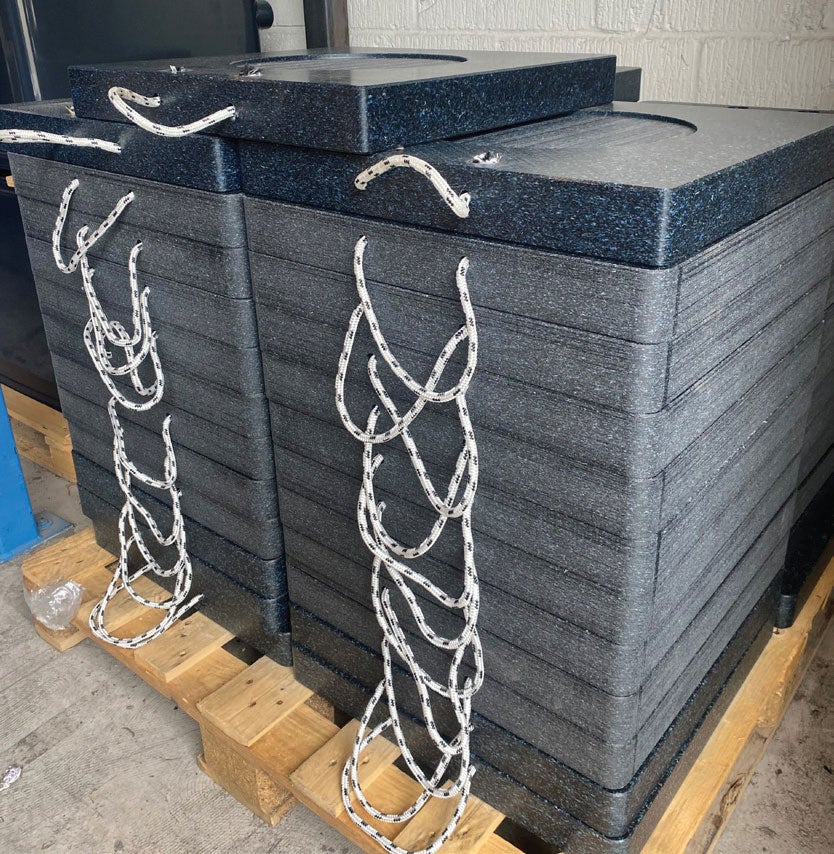
PCM’s pads are also designed to provide easier handling, with some interlocking options and pads with different lifting solutions to enable easier operation.
“Quality plastic pads that can be supplied with testing and materials certification from trusted suppliers still remain a good choice for small to medium lorry loader cranes, small access platforms and general surface protection applications and are very cost effective,” concludes Phelan. “For larger lorry loader cranes, mobile cranes and complex engineering projects then the larger modular mats produced from other materials may be more suitable.”
NEW MANUFACTURER
Iowa, USA-based Dica specialises in outrigger pads, crane pads, and cribbing and, for the first time since the company was founded in 1988, is now manufacturing its own ground protection mats.
The mats offer three different thicknesses, to suit a range of applications.
Ranger HD is a 4’ x 8’ mat with a thickness of half an inch, designed for light-duty temporary access where the primary requirements are hand deployment and surface protection.
The Defender mat measures 3’ x 6’, and is one inch in thickness, with overlapping flanges that lock together. It is suited to a wider range of ground conditions, says Dica, offering a more rigid surface for heavier equipment including rough terrains and boom trucks.
Finally, Dica has the Titan Access Mats designed to offer heavy-duty ground protection. These are two inches in thickness, cover 71 sq ft, and accommodate bigger loads including heavy mobile cranes and crawlers.
Kris Koberg, chief executive of Dica, explains the motivation and development process of the new mats: “Driven by ongoing pressure to reduce risk on all kinds of job sites, contractors and their customers are looking for ways to better protect people, equipment, and the job site itself.
“We have distributed ground protection mats from other companies in the past, but we became frustrated, along with our customers, with fluctuating availability and pricing. Dica saw an opportunity to bring clarity and confidence to a much-needed product category.
“Customers can expect the same quality and reliable performance from Dica’s new Ranger HD, Defender, and Titan ground protection mats that they get from other Dica outrigger pads, crane pads, and cribbing products.”

The company’s longstanding relationships with its clients enabled it to understand various demands that could be incorporated into the design of the new range.
“We’ve worked closely with contractors to supply ground protection products for at least 20 years, listening to their wants, needs, and frustrations,” says Koberg. “They are looking for a selection of products that meet different ground conditions for use with a variety of types of equipment. They want to be able to easily handle and store mats. They want confidence that mats won’t crack or fracture. And they are asking for affordable, readily available products.
“These insights informed not only product design, but how we manufacture, stock, and support the product line from day one. We’ve been ramping up for this launch, including an expansion of our facility announced last year, so that we can deliver high performance products at greater speed. We started shipping the new ground protection mats ahead of ConExpo.”
The company works with its customers to advise on which product best suits a given application, adds Koberg. “Dica views ground protection as part of a complete approach to safer equipment setup,” he says.
“The company works closely with operators to help match the right mat to the ground conditions, equipment weight, and duration of use, supporting standardised jobsite practices that reduce risk, protect surfaces, and reinforce a professional image.”
The three new mats cover a range of applications, says Koberg. “DICA developed the Ranger HD, Defender, and Titan mats so contractors can select the right solution based on ground conditions, equipment size and weight, and duration of use.
“These ground protection mats are suitable for use with equipment found in construction, crane operations, tree care, utility work – anywhere where the surface of the ground needs to be protected from the damage that can be caused by wheeled or tracked vehicles.
“For crane users, Ranger might be suitable where cranes must set up on poured concrete surfaces to finish lifting tasks. They help prevent smaller, supporting equipment – like telehandlers or boom lifts – from getting stuck.
“Defender and Titan mats are thicker and stiffer than Ranger mats. Titan mats provide the most stability, and will conform to the landscape, making them ideal for building crane access roads or laydown yards. Defender mats can be used for similar applications and are ideal when installation must be done by hand because other equipment is not available.”
The mats were also designed with two further considerations in mind: accommodating ambient temperature changes, and ease of handling.
“Ranger HD mats can be manually handled and positioned by one or two people, making them well-suited for fast setup and frequent repositioning,” says Koberg. “The connector design allows for controlled expansion and contraction as temperatures change, supporting consistent performance over time.
“Defender and Titan mats are engineered for longer-duration projects where stability is critical. Both are produced in grey to reduce heat and UV absorption, helping limit thermal expansion during extended deployments. When connected, these mats function as a unified system, creating stable access roads or work platforms.
“Defender mats provide increased stiffness and strength compared to Ranger HD while still allowing for manual placement by a two-person crew. Titan mats offer the highest load capacity that still conforms to the terrain, making them well-suited for soft or variable ground conditions where heavy equipment – such as mobile or crawler cranes –require a more substantial working surface. ”
FURTHER EXPANSION
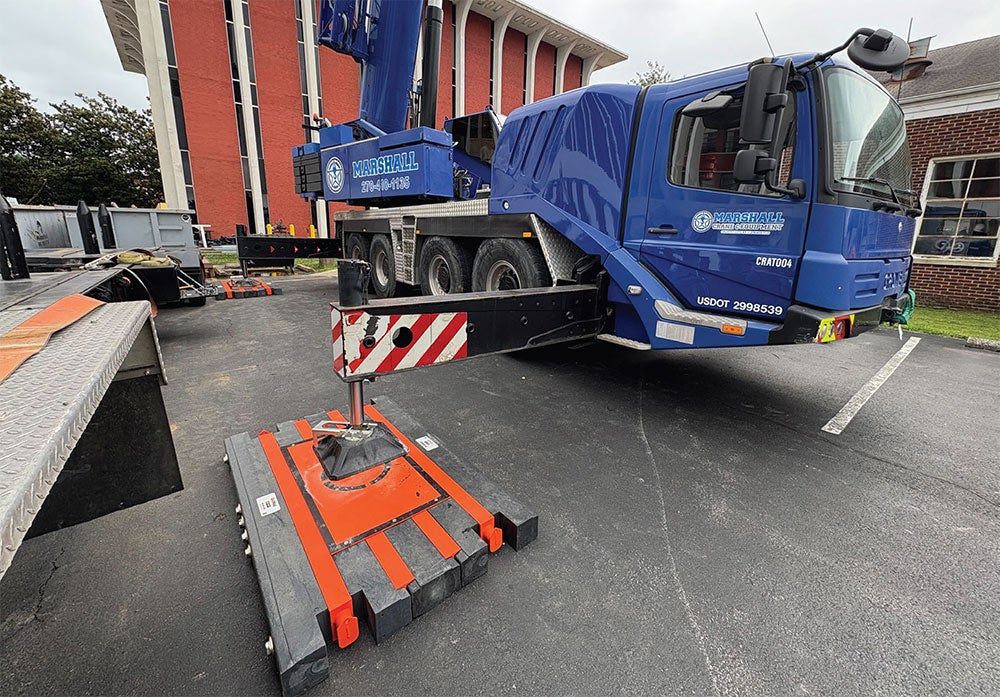
Dica’s launch of its new ground protection mats follows on from the introduction of its EcoMax Crane Pad in the second half of 2025.
The EcoMax is designed to combine the strength of steel with the durability and lower cost of recycled composite materials.
“EcoMax offers the durability to outlast timber, the strength of steel, and the cost savings of composite,” says Koberg. “For utility professionals and contractors, it’s a smarter way to get the performance needed without compromising safety or value.”
Again, the product was developed to offer versatility and ease of handling. “The product features two distinct rating scenarios,” says Koberg. “The first is the standard rated capacity, which applies when the pad is fully supported. The second, known as the ‘Bridge Rating’, applies in conditions where the ends of the pad are supported but there is a gap beneath the centre. This gives contractors flexibility to use EcoMax safely even in uneven ground conditions commonly encountered in utility construction.
“It also has built-in lifting lugs for safe handling of individual pads or full stacks with standard synthetic rope or chain slings, as well as steel components finished with a non-slip coating to improve friction and handling safety. The current EcoMax model is 24 sq ft and rated for a maximum capacity of 160,000 lbs (80 tons), making it ideal for cranes up to the 150-ton lifting class.”


